


🌾 Sabbath School Compact
Understand, deepen, and live the weekly lesson.
✉️ FIRST AND SECOND CORINTHIANS
🌅 Lesson 8 – The Power of Christ’s Resurrection
📅 Study Week: August 15–21, 2026
🕊️ Sabbath: August 22, 2026
📚 3rd Quarter 2026: 1 and 2 Corinthians
💎 Memory Verse
“And if Christ has not been raised, our preaching is useless and so is your faith.”
1 Corinthians 15:14
🧭 What Is It About?
Hardly any chapter in the New Testament shows as clearly as 1 Corinthians 15 how inseparably the cross, the resurrection, the second coming, and Christian hope are connected. Paul writes to a church in which some Christians apparently questioned the future resurrection of the dead. For him, however, this was not a minor doctrinal issue. If there were no resurrection of the dead, then Christ Himself would not have risen; and if Christ had not risen, the entire gospel would lose its foundation.
That is why Paul first reminds the Corinthians of what they had received from the beginning: Christ died for our sins, was buried, and rose again on the third day. He then names numerous people to whom the risen Jesus appeared. For the first Christians, the resurrection was not a beautiful metaphor for hope or a new beginning, but a real event. The Jesus who had died on the cross and been laid in the tomb was alive again.
This is precisely where the power of Christian hope lies. Our faith is not directed merely toward a Jesus who once lived and taught great truths, but toward the living Lord who conquered death and will come again.
📖 The Lesson at a Glance
Paul first shows that the resurrection of Jesus belongs to the very heart of the gospel. The cross must not be viewed in isolation. Christ died for our sins, but His work of redemption did not end in the grave. Through His resurrection, it became clear that sin and death could not defeat Him. Therefore, our hope of eternal life is directly connected with His resurrection.
Paul makes this importance especially clear by asking what would be true if Christ had not risen. Then the apostles’ preaching would be empty, faith would have no foundation, and the hope of those who had died would be destroyed. According to Paul, Christianity without the resurrection would not be a weakened form of faith, but a faith without substance. That is why his triumphant answer is: Christ has risen.
He calls Jesus the “firstfruits of those who have fallen asleep.” This image comes from the harvest. The firstfruits were the sign that the rest of the harvest would follow. In the same way, the resurrection of Jesus is the guarantee that those who belong to Christ will also rise. Paul explicitly connects this event with the second coming: “Then those who belong to Christ, at His coming” (1 Cor. 15:23).
This leads the lesson directly to the biblical teaching about the state of the dead. Christian hope does not consist in the idea that human beings are naturally immortal. Rather, Paul directs our attention to the day when Christ will return and raise the dead. That is why death is repeatedly compared with sleep in the Bible. The dead do not consciously wait for centuries for the second coming; for them, the next conscious moment will be Christ’s call to resurrection.
This perspective also explains why 1 Corinthians 15 would make no sense if the redeemed had already begun their final heavenly existence immediately after death. Paul places his hope not in death, but in resurrection. The grave does not bring completion; Christ does at His second coming.
Another important thought appears in Paul’s words: “Let us eat and drink, for tomorrow we die” (1 Cor. 15:32). He is certainly not calling people to a pleasure-centered life. Rather, he shows where life without resurrection hope could lead. If this life were everything, people could easily conclude that only the present moment matters. But because there is resurrection, judgment, and eternity, our present life has lasting significance. Faithfulness, sacrifice, mission, forgiveness, and obedience are not in vain.
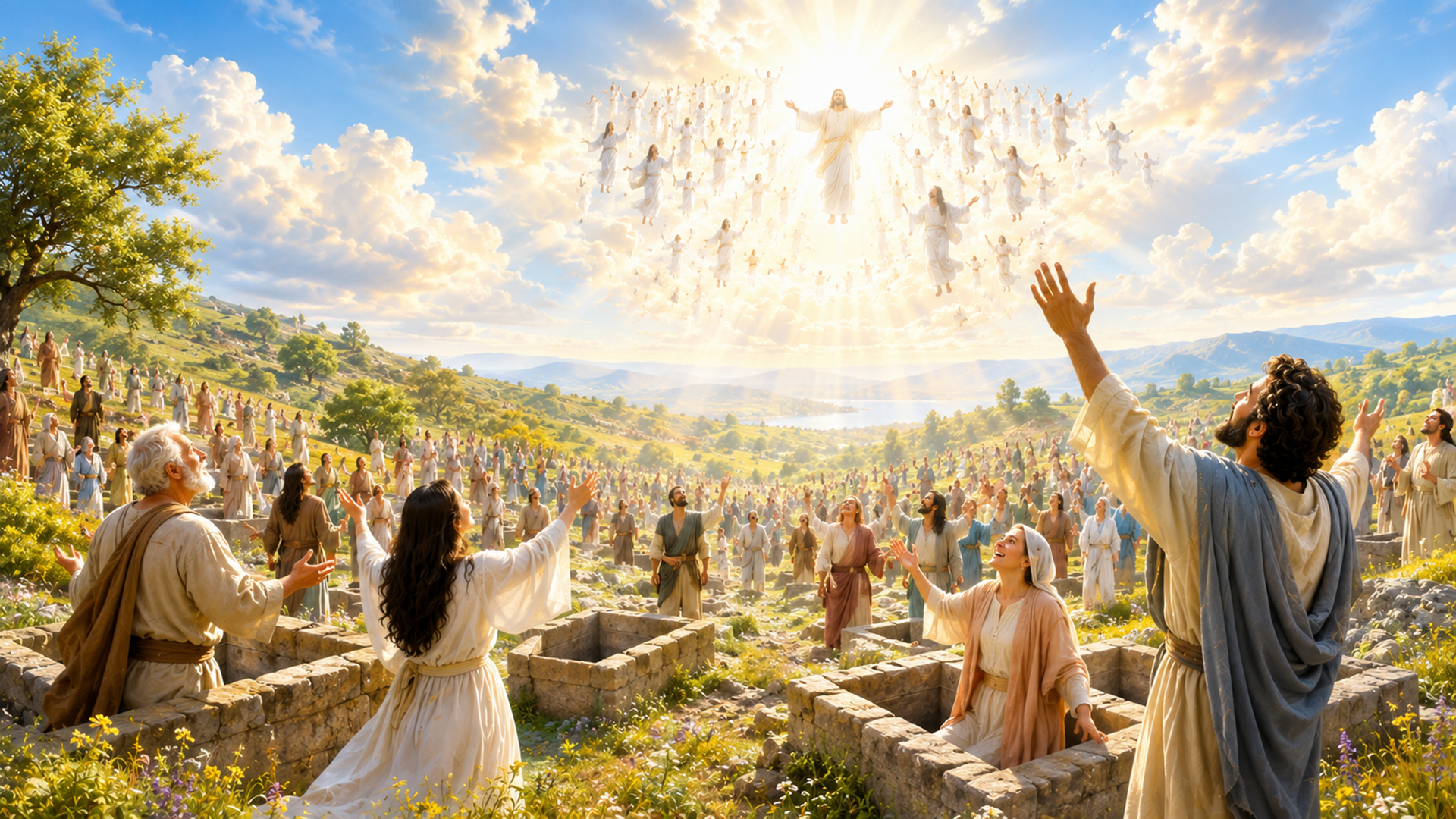
At the end of the chapter, Paul directs our attention fully toward the second coming of Jesus. The dead will rise, living believers will be transformed, and mortality will put on immortality. This wording is especially important. Human beings do not naturally possess immortality within themselves; it is God’s gift. At the resurrection and transformation, Christ gives His redeemed the life that death can no longer touch.
Then what now seems impossible will finally take place: death itself will be defeated.
🔎 A Thought Deeper
The resurrection of Jesus changes not only our understanding of death, but also our view of life. Whoever believes that Christ has risen and will return no longer lives as though the present were everything. The value of a life is then not measured only by success, possessions, health, or human recognition. Even a life filled with sacrifice, disappointment, or unanswered questions can have eternal significance in God’s sight.
This is one of the strongest messages of 1 Corinthians 15. Paul does not ignore death, nor does he make it seem harmless. He even calls it the “last enemy.” But this enemy has an expiration date. Death may still separate people today, but it will not separate them forever. It may close graves, but Christ will open them again.
For someone standing at a grave, this is more than a theological statement. Christian hope does not say: “Death is simply part of life.” It says: Death belongs to a fallen world that Christ will restore.
🔗 The Bible Explains the Bible
Other passages confirm this picture as well. In John 11:25, Jesus says to Martha: “I am the resurrection and the life.” Our hope is therefore not first of all a theory about the afterlife, but a Person. In 1 Thessalonians 4:13–17, Paul describes the same hope again: When Christ returns, the dead in Christ will rise, and the living believers will meet the Lord together with them. Philippians 3:20–21 adds that Christ will transform our mortal bodies, and Revelation 21 finally brings the story to its goal: a world without death, suffering, pain, or tears.
These passages belong together. They show a clear line: Christ has risen, Christ will come again, the dead will rise, the redeemed will be transformed, and death will finally disappear.
💬 Questions for Reflection
How can we be witnesses of Jesus’ resurrection today even though we were not eyewitnesses? We can pass on the apostolic testimony, but our witness goes beyond that. A life transformed by Christ shows that the risen Lord is still at work today.
Why is the resurrection indispensable to the gospel? Because without the resurrection, the cross would end in a grave. The resurrection shows that Christ conquered death and that His work of redemption ended not in defeat, but in victory.
What does resurrection hope change in our daily lives? It reminds us that our decisions have eternal significance. We do not have to squeeze everything possible out of this present life, but may live faithfully, serve, forgive, and hope because we know that God does not end our story at the grave.
🌱 Understand – Deepen – Live
The central truth of this week can be summarized simply: Because Christ lives, our hope is alive as well. The resurrection of Jesus is not merely an event of the past, but the guarantee of our future. It connects the cross with the second coming and gives us assurance that death will not have the final word.
But this truth is meant not only to be understood, but lived. Whoever believes in the resurrection may look at loss differently, carry difficulties differently, and await the future differently. Christian hope does not mean suppressing pain. It means knowing, even in the midst of pain, that God is not finished yet.
📜 Ellen White on the Topic
Ellen White repeatedly connects the resurrection of the redeemed directly with the second coming of Christ. For her, the raising of Lazarus was a preview of that great day when Christ will call those who have fallen asleep in Him from their graves. Human beings do not carry the source of eternal life within themselves; Christ Himself is the Life-giver.
Her presentation therefore agrees with the emphasis of 1 Corinthians 15: Our hope does not rest on an allegedly natural immortality of human beings, but on the risen Christ, who at His second coming will clothe mortality with immortality.
✨ The Thought for This Sabbath
Perhaps we understand the meaning of 1 Corinthians 15 most deeply when we stand at a grave. There everything seems final. A life has ended, a voice has fallen silent, a person is missing. Yet it is precisely there that the gospel speaks its strongest word of hope.
Jesus Himself passed through death and lay in the grave. But the grave could not hold Him. Therefore, no grave of a person who has died in Christ should be regarded as the final ending. It is a temporary place of rest until the day when the Life-giver returns.
Then the trumpet will sound, the dead will rise, the living will be transformed, and mortality will put on immortality. Only then will the victory become fully visible.
The resurrection of Jesus is therefore not merely the remembrance of a miracle from the past. It is God’s guarantee that our future does not end in death either.
