


✉️ FIRST AND SECOND CORINTHIANS
🎁 Lesson 6: Spiritual Gifts
🧩 6.2 Unity Through Diversity
🤝 One Body, Many Members, and One Common Mission
📖 1. Introduction
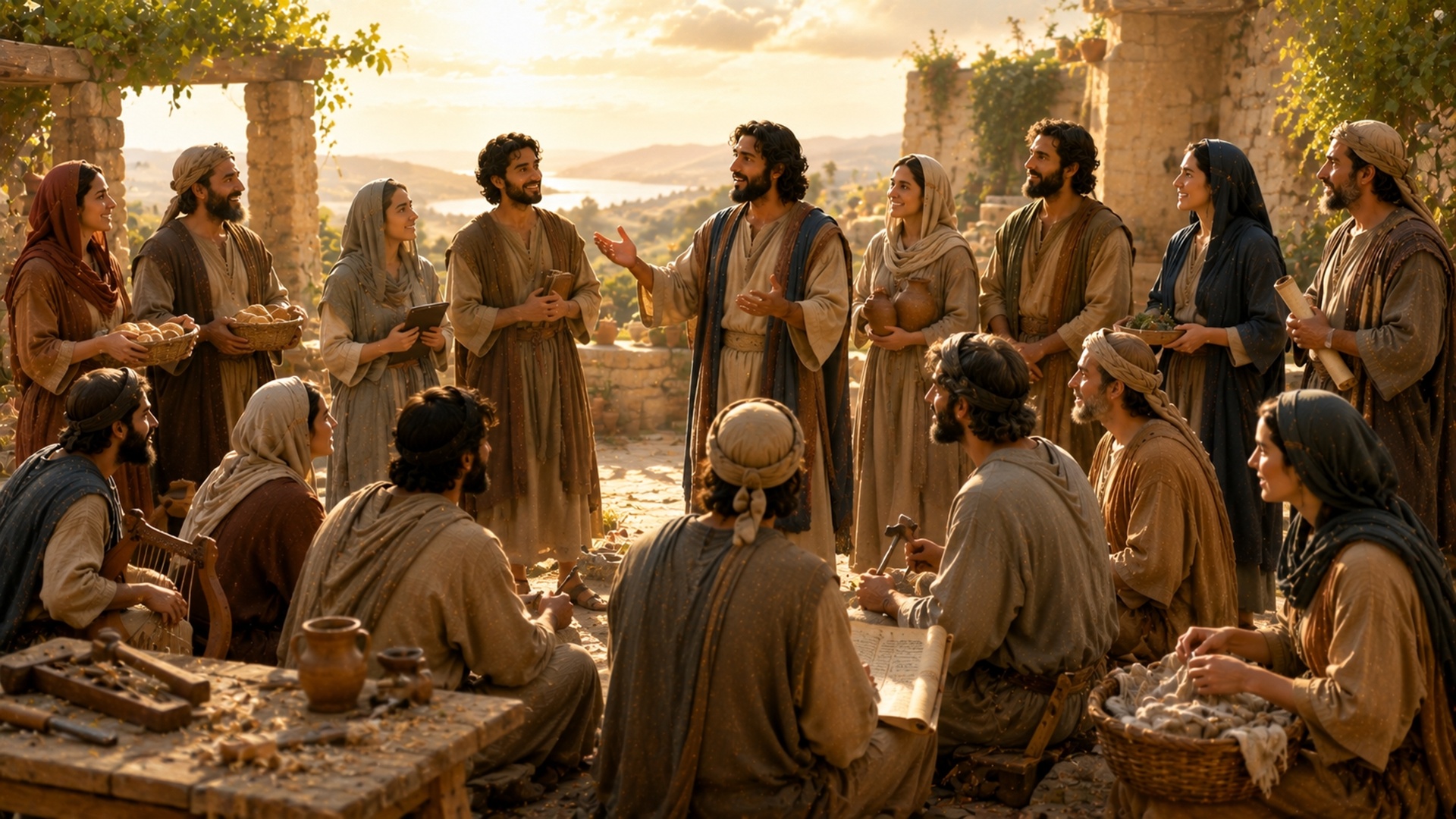
Paul describes the church using a very simple yet profound image: the human body. A body consists of many members, and each member has its own function. The eye sees, the hand grasps, the foot walks, and the ear hears. No part can do everything by itself, and no part is unnecessary. The same is true of the church of Christ. God gives different gifts so that they may not produce competition, but mutual support, unity, and shared service.
📜 2. The Biblical Foundation
Paul writes:
“For as the body is one and has many members, but all the members of that one body, being many, are one body, so also is Christ.” 1 Corinthians 12:12
He then explains:
“For by one Spirit we were all baptized into one body.” 1 Corinthians 12:13
And further:
“But now God has set the members, each one of them, in the body just as he pleased.” 1 Corinthians 12:18
Paul also emphasizes:
“And the eye cannot say to the hand, ‘I have no need of you.’” 1 Corinthians 12:21
These verses show that the church lives through unity, diversity, and mutual dependence.
🌍 3. Connection to Our Time
Churches today are also made up of very different people. Some serve in visible roles, while others work quietly in the background. Some are gifted speakers, while others are good listeners. Some lead, while others offer practical help, pray faithfully, encourage, visit, organize, or serve unnoticed. Yet, as in Corinth, there is still a danger that visible gifts may be valued more highly than quiet forms of service. Paul reminds us that God needs all the members and that the church remains healthy only when each member recognizes his or her place and respects the others.
💡 4. Central Message of the Lesson
👉 The church is one body with many members: everyone is important, everyone needs the others, and all gifts are meant to serve Christ together and build up his church.
✝️ 5. Theological Focus
The central theological thought of this lesson is the unity of the body of Christ. Paul does not merely say that the church is like a body. He says, “So also is Christ.” In this way, he shows that the church is not simply a human organization, but the body of Christ. It belongs to Jesus, is guided by him, and is meant to reveal his character to the world.
This unity does not arise from identical abilities, personalities, or responsibilities. It comes through the one Spirit. Paul writes that all were baptized by one Spirit into one body. This means that our deepest connection does not lie in background, education, age, culture, opinion, or personal sympathy, but in Christ and in the Holy Spirit.
The church is therefore more than a group of people with similar interests. It is a spiritual community created by God. Every believer is not added by accident, but is placed by God into the body. Paul says: “God has set the members, each one of them, in the body just as he pleased.”
This gives dignity to every person. No one is in the church by accident. No one is worthless. No one is merely a spectator. God has given each person a place. Even when a ministry appears small, it may be very important in God’s plan.
At the same time, this image protects us from pride. The eye may not say to the hand, “I do not need you.” No member can live independently of the others. Those who possess visible or influential gifts must never think that they are more important than others. There are no self-sufficient lone workers in the body of Christ.
The image of the body also shows that diversity is necessary. A body made entirely of eyes would be unable to hear, walk, or grasp. In the same way, a church would be unhealthy if everyone had the same gift. God gives different gifts because different tasks must be fulfilled.
Paul therefore confronts two false attitudes. The first says, “I am not important because I am not as gifted as others.” The second says, “I am more important because my gift is more visible.” Both attitudes destroy unity. The first leads to feelings of inferiority, while the second leads to arrogance.
The gospel heals both. Those who feel inferior may know: God has placed you in the body. Those who become proud must recognize: You need the others. All members live by the same grace and belong to the same Lord.
Another important thought is mutual care. Paul says that the members should have the same concern for one another. If one member suffers, all suffer with it. If one member is honored, all rejoice with it. This is a deep spiritual unity that goes far beyond mere cooperation.
The theological core is this: The church is the one body of Christ, in which diverse members are united by the one Spirit. Every gift is necessary, but no gift is independent. Unity does not arise in spite of diversity, but through diversity ordered by Christ.
🌟 6. Spiritual Deepening
This lesson speaks directly to the heart of many churches. Wherever people come together, differences arise. Different gifts, temperaments, opinions, working styles, and spiritual experiences can easily create tension. Paul shows, however, that diversity is not the problem. The problem arises when diversity is lived without love, humility, and a common focus on Christ.
God loves diversity. He does not create all people alike. Even in creation, we see a wonderful variety of colors, forms, voices, landscapes, and ways of life. Diversity within the church also reflects something of God’s wisdom. The Holy Spirit does not work monotonously, but richly and in many different ways.
Yet diversity needs a center. Without Christ, diversity quickly becomes competition. People then defend their own opinions, ministries, groups, or preferences. With Christ at the center, diversity becomes a blessing because all gifts serve the same Lord.
Unity therefore does not mean uniformity. Paul does not demand that everyone do the same thing, think in exactly the same way, feel the same way, or have the same ministry. Unity means that everyone submits their differences to Christ. The foot remains a foot, the hand remains a hand, and the eye remains an eye, but they all belong to one body.
This truth especially helps those who feel insignificant. Some Christians see others preaching, teaching, singing, leading, or serving publicly and think, “I have nothing to contribute.” But Paul disagrees. The very members that seem weaker are necessary. God sees forms of service that people often overlook.
A quiet prayer can sustain the church. A kind word can protect someone from discouragement. A visit can make love visible. Practical help can open a heart. Faithful service in the background can mean more than many people realize. In the body of Christ, it is not only what attracts attention that matters, but what is done faithfully.
At the same time, Paul warns those with visible gifts. Anyone who stands at the front must never forget that he or she needs others. Preachers need people who pray. Teachers need people who listen and apply what they learn. Leaders need servants. Musicians need spiritual humility. No one builds the church alone.
The image of the body also shows that dependence is not a sign of weakness. God created us to need one another. Spiritual independence can become dangerous. Anyone who believes that he can live without the church, without correction, without fellowship, and without the gifts of others is moving away from the biblical image of the body.
A body suffers when one member is injured. In the same way, the church should not remain indifferent when a member suffers, falls, is absent, or becomes discouraged. Paul calls us to genuine mutual care. The church is not merely a place one attends, but a body to which one belongs.
This also changes the way we respond to success and honor. When one member is honored, everyone should rejoice. Envy has no place in the body of Christ. When God uses someone else, the value of my gift does not diminish. On the contrary, the whole body is strengthened.
This attitude is possible only through love. That is why, at the end of 1 Corinthians 12, Paul leads directly to the “more excellent way” of love. Without love, gifts become instruments of pride. With love, they become instruments of blessing. Love helps us respect others, accept our own limitations, and serve Christ together.
Unity through diversity also produces missionary strength. A church with different gifts can reach different kinds of people. Some are touched through preaching, others through personal conversations, practical help, music, pastoral care, hospitality, or patient friendship. God uses many different ways to reach people.
Every believer should therefore ask: Where has God placed me in his body? Whom do I need? Whom can I serve? Which gift in another person should I appreciate more? When such questions are asked honestly, the church grows in humility and unity.
Christ is the head of this body. From him come life, direction, and strength. When the members remain connected to the head, they can also remain connected to one another. Where Christ reigns, diversity does not lead to division, but becomes the beauty of shared service.
🔧 7. Application in Everyday Life
Practical Steps:
- Gratefully recognize that God has given you a place in the body of Christ.
- Do not constantly compare your gift with the gifts of others.
- Value quiet and unnoticed ministries within the church.
- Rejoice when God uses others instead of becoming envious.
- Ask yourself whom you can strengthen through your gift.
- Seek cooperation rather than working alone.
- Care for people who are suffering, absent, or discouraged.
- Ask God to lead your church into greater love, humility, and unity.
❓ 8. Reflection Question
Do I see my church merely as a group of individuals, or truly as one body in which God has intentionally placed both me and the others?
🌟 9. Concluding Thought
Paul shows that unity and diversity belong together in the body of Christ. Every believer has a place, a task, and significance. No one should exalt themselves above others, and no one should feel worthless. God has placed the members as he desired so that they may complement one another and serve Christ together. A healthy church does not live by competition, but by mutual respect, love, and shared devotion. When many members work together under one Lord, the body of Christ is strengthened and God’s mission becomes visible.
“Now you are the body of Christ, and members individually.” 1 Corinthians 12:27 🧩🤝🙏✨
