


✉️ FIRST AND SECOND CORINTHIANS
🎁 Lesson 6. Spiritual Gifts
🗣️ 6.4 The Gift of Tongues
📖 Understandable Words for Building Up the Church
📖 1. Introduction
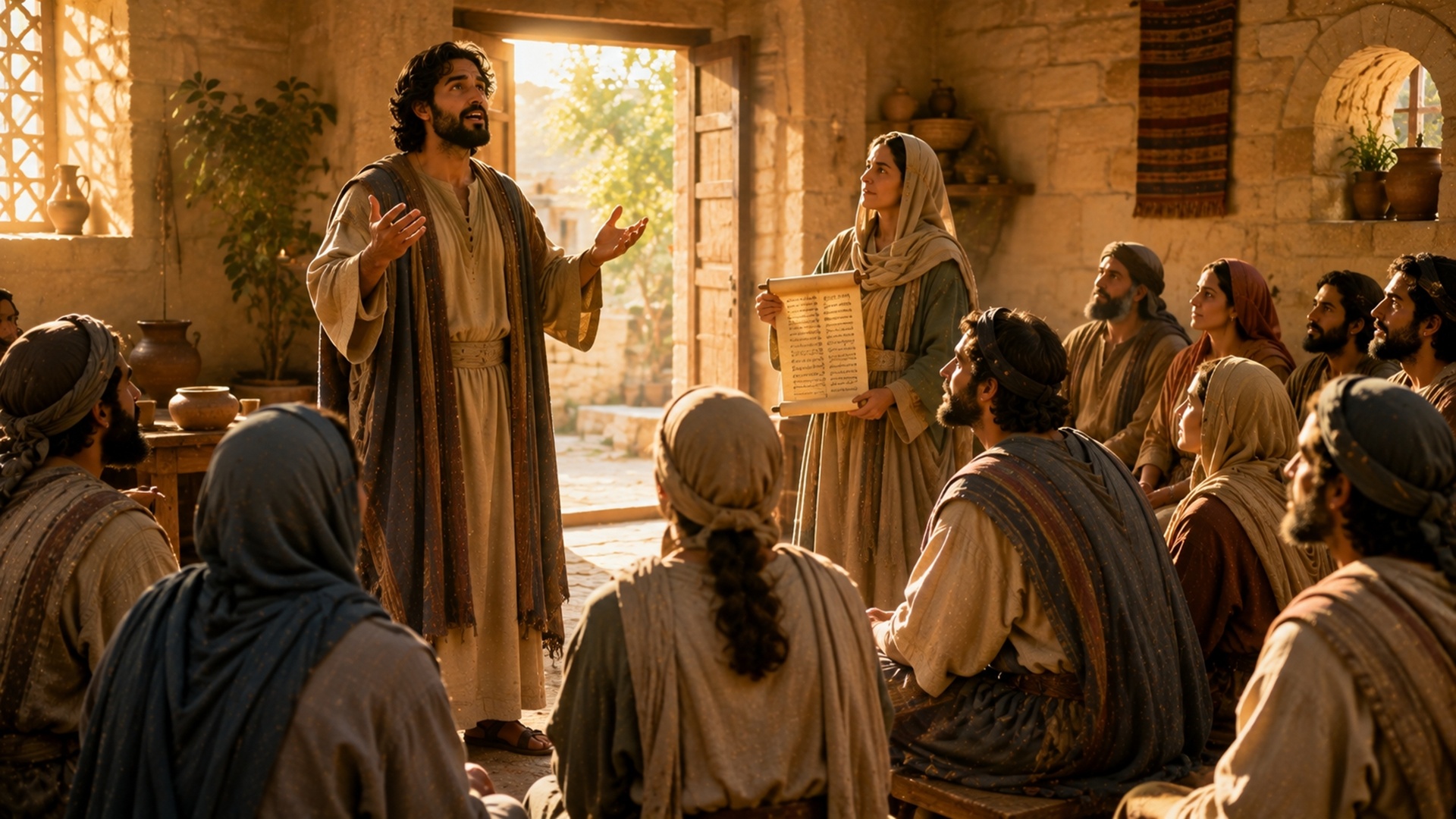
Paul speaks extensively in 1 Corinthians 14 about the gift of tongues because it was apparently misunderstood and misused in Corinth. Some Christians valued this gift very highly, perhaps because it appeared striking and impressive. Yet Paul shows that a gift fulfills its purpose only when it builds up the church. Words that no one understands may seem extraordinary, but they do not help the congregation. Therefore, Paul places great emphasis on intelligibility, interpretation, and order. Spiritual gifts are not meant to create confusion but to testify of Christ and strengthen people in faith.
📜 2. The Biblical Foundation
Paul writes:
“I wish that all of you could speak in tongues, but I would rather have you prophesy.”
1 Corinthians 14:5
Then he explains:
“But the one who prophesies speaks to people for their strengthening, encouragement, and comfort.”
1 Corinthians 14:3
Concerning intelligibility, Paul says:
“Unless you speak intelligible words with your tongue, how will anyone know what you are saying?”
1 Corinthians 14:9
And concerning order in worship, he writes:
“If anyone speaks in a tongue, two—or at the most three—should speak, one at a time, and someone must interpret.”
1 Corinthians 14:27
At the end Paul summarizes:
“But everything should be done in a fitting and orderly way.”
1 Corinthians 14:40
🌍 3. Connection to Our Time
Even today, there are different views concerning the gift of tongues. Some see it as a necessary sign of special spirituality, while others reject it completely. Paul helps us to think soberly and biblically. He does not reject the gift, but he places it under clear spiritual principles: It must be understandable, interpreted, and serve the church. A gift that merely draws attention to a person or creates disorder does not correspond to the purpose of the Holy Spirit. The Spirit of God does not work for self-display but for edification, clarity, and the glorification of Christ.
💡 4. Central Message of the Lesson
👉 The gift of tongues is spiritually meaningful when it is made understandable, testifies of Christ, and builds up the church in love, order, and truth.
✝️ 5. Theological Emphasis
The theological emphasis of this lesson lies in the purpose of spiritual speech. Paul does not question the existence of the gift but its use. He asks: Does what is happening truly serve to build up the church? Does it lead people closer to Christ? Is God’s truth communicated in an understandable way?
In the Bible, the gift of tongues appears especially clearly in Acts 2. There the disciples, through the Holy Spirit, speak in languages that people from different countries were able to understand. The goal was not an unintelligible religious experience but mission. People were to hear the mighty works of God in their own language.
In 1 Corinthians 14, intelligibility also remains a central principle. Paul says that words without understandable meaning provide no benefit. If no one understands what is being said, the church is not built up. Worship, however, should not consist of impressive sounds but of truth that reaches both heart and mind.
Therefore, Paul connects speaking in tongues with interpretation. If a foreign language is spoken, it should be translated or explained. Without interpretation, the speaker should remain silent and speak to himself and to God. This shows that Paul is not seeking enthusiasm without order but spiritual clarity.
It is especially important that Paul does not present speaking in tongues as a mandatory sign for all Christians. In 1 Corinthians 12 he asks: “Do all speak in tongues?” The expected answer is no. Not everyone receives the same gift. The Holy Spirit distributes gifts to each person as He wills.
This means that speaking in tongues is not a prerequisite for being filled with the Holy Spirit. The most fundamental work of the Spirit is confessing Jesus as Lord, a transformed life, and the fruit of the Spirit. No single gift should ever be made the standard of genuine spirituality.
Paul ranks the gifts according to their usefulness for the church. Therefore, in 1 Corinthians 14 he places prophecy above speaking in tongues when there is no interpretation. Prophetic speech is understandable, exhorts, comforts, and builds up. An uninterpreted language, by contrast, remains incomprehensible to the listeners.
This reveals an important theological principle: The Holy Spirit does not work against the mind. He renews both heart and thinking. He does not bring confusion but light. Faith is not merely emotion but a response to God’s clearly revealed truth.
Worship should therefore be orderly. Paul says: “God is not a God of disorder but of peace.” Spiritual vitality and order are not opposites. The genuine work of the Spirit does not lead to chaos but to worship in which Christ is clearly recognized and the church is strengthened.
The theological core is this: Spiritual speech must serve Christ, be understandable, and build up the body of Christ. A gift is not valuable because it is spectacular, but because it is used in the spirit of love and truth.
🌟 6. Spiritual Deepening
This lesson helps us evaluate spiritual experiences correctly. Not everything that appears impressive is automatically spiritually mature. Not everything that seems extraordinary truly builds up the church. Paul leads us away from fascination and toward the question of fruit, clarity, and love.
The Corinthians were apparently strongly attracted to spectacular gifts. This is understandable from a human perspective. People often pay attention to what is unusual, visible, and extraordinary. But God does not first ask about the impression something makes; He asks about its spiritual benefit. Is Christ magnified? Is the church strengthened? Is truth understood?
This is especially important when it comes to speaking. Words have power. They can comfort, encourage, teach, warn, and heal. But words can also confuse, divide, or impress people in the wrong way. Therefore, spiritual speech should always be guided by love.
Paul shows that intelligibility is an expression of love. Whoever speaks in worship is not speaking for himself but for others. Love asks: Can the others understand? Are they being built up? Can they say Amen? Are they being led to God?
This is an important principle for preaching, teaching, prayer, testimony, and music. Spiritual ministry should not merely sound beautiful or powerful but should truly reach people. If our language is too complicated, too unclear, or too self-centered, it may miss its purpose. Christ should be proclaimed in an understandable way.
This lesson also protects us from spiritual pride. If one gift is regarded as a sign of higher spirituality, a two-class mentality quickly develops. Some feel superior, while others feel inferior. Paul clearly opposes this: Not everyone has the same gift, but all belong to the same body.
A Christian therefore does not need to feel inferior if he does not possess a particular gift. God distributes gifts according to His will. Whoever faithfully loves, serves, believes, prays, and confesses Christ does not stand lower than someone with a spectacular gift. What counts before God is not outward extraordinariness but faithfulness, love, and obedience.
At the same time, we should not despise a genuine gift. Paul does not say: “Forbid speaking in tongues.” But he does say: “Let everything be done for edification.” That is the biblical balance. We should be open to the work of the Holy Spirit, but we should also soberly examine whether something agrees with God’s Word, order, and the building up of the church.
The gift of languages also reminds us of the missionary calling of the church. God wants people to hear the message in a language they understand. This applies not only linguistically but also spiritually and culturally. Whoever testifies of Christ should speak in such a way that people are truly reached.
In a diverse world, this is especially important. Churches often include people from different countries, cultures, and language groups. Those who speak several languages can become a bridge for the gospel. Translation, personal conversations, Bible studies, and prayer in an understandable language can open doors that would otherwise remain closed.
Therefore, the true nature of this gift is not self-display but service. The Holy Spirit enables people to communicate God’s truth. He overcomes language barriers so that Christ may become known. He gives words so that people can understand, believe, and grow.
Paul’s concern remains very practical: What happens in worship should be helpful to others. When people enter, they should not be confused but addressed. They should recognize God’s presence, understand God’s Word, and be led to worship.
The Spirit of God does not work against order. He can work powerfully and at the same time create peace. He can give gifts and at the same time require humility. He can move people and at the same time keep the Word of God at the center.
This lesson invites us to surrender our words to God. Not only special spiritual gifts but all our speech should serve to build others up. Our conversations, testimonies, prayers, and explanations should be understandable, loving, and Christ-centered. For words guided by God’s Spirit bring light instead of confusion.
🔧 7. Application in Everyday Life
Practical Steps:
- Always test spiritual experiences by the Word of God.
- Make sure that your words build others up rather than merely impress them.
- Speak about faith in an understandable, loving, and clear way.
- Do not despise any genuine gift, but do not make any one gift the standard for everyone.
- Ask God to use your words for encouragement and testimony.
- Use your language skills to reach people with the gospel.
- Seek order, clarity, and consideration in worship.
- Ask in every ministry: Does this help others understand Christ better?
❓ 8. Reflection Question
Are my words in matters of faith aimed more at impressing others, or do they truly help people see Christ more clearly?
🌟 9. Closing Thought
Paul shows that the gift of tongues is used meaningfully only when it becomes understandable and builds up the church. The Holy Spirit gives gifts not for confusion but for strengthening faith and proclaiming Christ. Therefore, no gift should become a means of self-display or a sign of spiritual superiority. What matters is not how extraordinary a gift appears, but whether it is used in love, order, and truth. God wants His message to be understood. When our words clearly testify of Christ and lead people to God, they fulfill their spiritual purpose.
“But everything should be done in a fitting and orderly way.”
1 Corinthians 14:40 🗣️📖🙏✨
