


✉️ FIRST AND SECOND CORINTHIANS
🌅 Lesson 8. The Power of Christ’s Resurrection
🏆 8.5 Final Victory Over Death
🔔 Christ defeats death and gives imperishable life
📖 1. Introduction
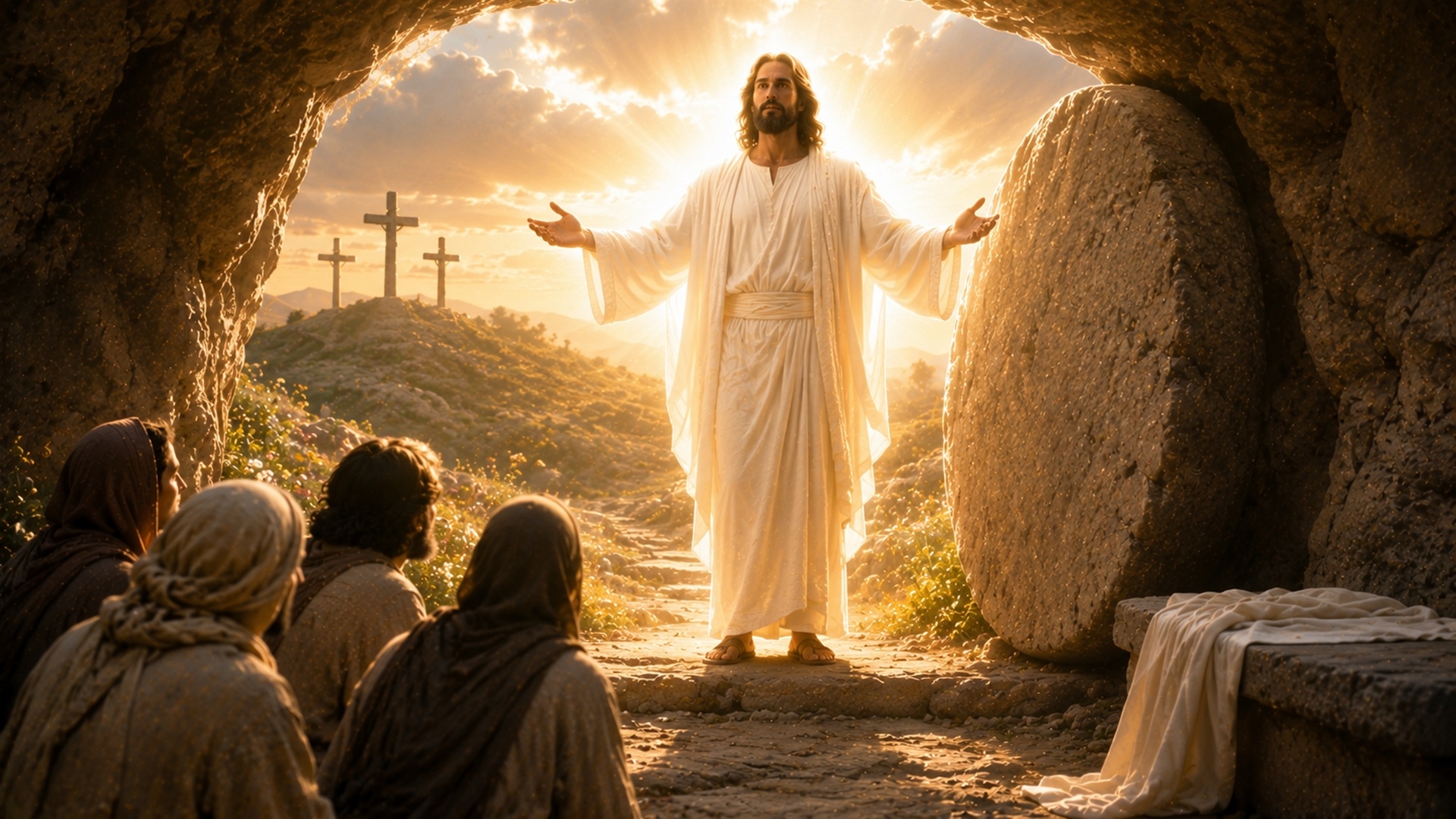
Paul brings his great teaching on the resurrection to a triumphant climax. Death, which has hung over humanity like a dark shadow since the Fall, will not reign forever. At the second coming of Christ, the dead in Christ will rise and the living will be transformed. Then the perishable will put on imperishability and the mortal will put on immortality. Paul is not speaking of a bodiless existence, but of a complete transformation through the power of God. The final victory belongs not to the grave, but to Jesus Christ.
📜 2. The Biblical Foundation
Paul writes:
“Flesh and blood cannot inherit the kingdom of God; nor does the perishable inherit the imperishable.”
1 Corinthians 15:50
Then he reveals the great mystery:
“We shall not all sleep, but we shall all be changed.”
1 Corinthians 15:51
And he continues:
“For the trumpet will sound, and the dead will be raised imperishable, and we shall be changed.”
1 Corinthians 15:52
Then comes the cry of victory:
“Death is swallowed up in victory. O death, where is your victory? O death, where is your sting?”
1 Corinthians 15:54–55
And Paul concludes with thanksgiving:
“But thanks be to God, who gives us the victory through our Lord Jesus Christ!”
1 Corinthians 15:57
These texts show: Victory over death is God’s gift through Christ.
🌍 3. Connection to Our Time
Death is still one of the deepest experiences of human helplessness. No progress, no medicine, no philosophy, and no human power can ultimately defeat it. We can prolong life, relieve pain, and preserve memories, but by our own strength we cannot escape death. Paul, however, proclaims a hope greater than human comfort. At His second coming, Christ will finally break the power of death. Therefore, Christians do not live out of despair, but out of the certainty that Jesus is Lord over life and death.
💡 4. Central Message of the Lesson
👉 At the second coming of Christ, the dead in Christ will rise and the living will be transformed; then death will be finally defeated and God’s children will receive imperishable life.
✝️ 5. Theological Focus
The theological focus of this lesson lies in the final transformation of the human being at the second coming of Christ. Paul says, “Flesh and blood cannot inherit the kingdom of God.” By this he does not mean that human beings will be bodiless in the kingdom of God. The context shows that “flesh and blood” refers to the present perishable, mortal condition of humanity marked by sin.
Paul therefore does not contrast bodily existence with spirituality, but perishability with imperishability. Our present body is mortal, weak, and subject to decay. This condition cannot inherit the kingdom of God. Therefore, humanity needs not merely comfort, but transformation.
This transformation takes place at the second coming of Jesus. Paul speaks of the last trumpet. Then the dead in Christ will rise, and the living believers will be transformed. This shows that Christian hope does not lie in an eternal intermediate state, but in resurrection and glorification at the coming of Christ.
The resurrection is therefore bodily and holistic. God does not save only an invisible part of the human being, but the whole person. Sin has affected the whole person: body, mind, relationships, life, and mortality. Therefore, redemption also embraces the whole person.
Paul says that the perishable must put on imperishability and the mortal must put on immortality. Immortality, therefore, is not something human beings naturally possess. It is given by God. Humanity is not immortal by nature; eternal life is a gift through Christ.
This is an important biblical truth. Since the Fall, death has been a reality. The serpent’s lie was: “You will surely not die.” But the Bible shows that death truly is the wages of sin. God alone possesses original immortality, and He gives life through Christ.
Victory over death is therefore inseparably connected with victory over sin. Paul says, “The sting of death is sin.” Death has power because sin separates human beings from God. Without a solution to sin, there could be no victory over death.
Then Paul adds, “The power of sin is the law.” This does not mean that God’s law is evil. The law reveals God’s holy standard and exposes sin as sin. Because humanity is guilty, it stands under the judgment of the law. The law can expose sin, but it cannot redeem the sinner.
Therefore, victory comes through Jesus Christ alone. He perfectly fulfilled the law, bore sin, suffered death, and through His resurrection broke the power of death. Our hope does not rest on our own righteousness, but on His victory.
The theological core is this: Death is not overcome by human strength, natural immortality, or philosophical comfort, but by Christ alone. At His second coming, He gives His people resurrection, transformation, and imperishable life.
🌟 6. Spiritual Reflection
This lesson addresses one of humanity’s deepest fears: the fear of death. Death appears final, cold, and unconquerable. It takes people away from us, breaks relationships, and reminds us that we do not have our lives fully in our own hands.
Paul does not minimize death. He calls it an enemy. But he shows that this enemy will not reign forever. Through His resurrection, Christ has already won the decisive victory, and at His second coming this victory will become fully visible.
This gives Christian grief a distinctive character. Christians grieve, but not without hope. They weep, but not like people for whom the grave has the final word. Their hope is not based on human memory, but on God’s promise of resurrection.
The biblical teaching of death as sleep makes this hope especially clear. Whoever dies in Christ does not consciously experience the passage of time. The next conscious experience will be the call of Christ at His second coming. For the believer, therefore, the return of Jesus will truly seem “soon,” even if from a human perspective many years or centuries have passed.
This truth also helps us understand the so-called delay of the second coming. From the perspective of the living, the time may seem long. But for those who have died in Christ, there is no conscious waiting. They close their eyes in death, and the next thing they experience is Christ in glory.
This gives comfort at gravesides. Death separates, but it does not erase God’s promise. No grave is too old, no body too decayed, no life forgotten. The God who formed humanity from the dust can also call His people back to life.
Paul’s cry of victory is therefore not superficial. “O death, where is your victory?” is not a human shout of courage against a harmless reality. It is the rejoicing over Christ’s victory. Death still has power in this world, but it has lost its ultimate future.
This victory also changes the way we live today. If death does not have the final word, then we do not have to live for what is temporary. We do not have to desperately try to extract everything possible from this life as though there were no future. We may live faithfully, hopefully, and courageously because our lives are secure in Christ.
The hope of transformation also helps us deal with physical weakness. Our bodies are perishable, but not worthless. They are weak, but created by God. They suffer, but they will be transformed. Sickness, aging, and pain are real, but they are not final.
This hope protects us from two extremes. We do not despise the body as though only a bodiless soul mattered. But neither do we idolize it as though it must be perfect now. We live responsibly with our bodies, but our ultimate hope lies in God’s future transformation.
Victory over death also calls us to gratitude. Paul does not say, “Thanks be to our effort.” He says, “Thanks be to God.” Victory is a gift. Resurrection is a gift. Immortality is a gift. Eternal life is a gift. Everything comes through Jesus Christ.
Therefore, this lesson is deeply centered on the gospel. Death is defeated because Christ died and rose again. Sin is overcome because Christ bore our guilt. The law no longer condemns us when we are in Christ, because He is our righteousness.
This hope is meant to make our hearts steadfast. Paul ends the chapter with the call to be steadfast, immovable, and always abounding in the work of the Lord. Why? Because our labor in the Lord is not in vain. The resurrection gives meaning to faithfulness. Nothing done in Christ is lost.
So when we look at suffering, death, and mortality, we may hear God’s final word: victory. Not because we are strong, but because Christ lives. Not because death is harmless, but because Jesus is stronger. Not because we understand everything, but because God’s promise is sure.
🔧 7. Application in Daily Life
Practical Steps:
- When facing death and loss, consciously remember the promise of the resurrection.
- Comfort yourself and others with the hope of Jesus’ second coming.
- Do not live as though this temporary life were everything.
- Thank God daily for the victory Christ has won.
- Trust that God will redeem the whole person.
- Do not allow sickness, aging, and weakness to rob you of hope.
- Use your strength for the work of the Lord because it is not in vain.
- Hold firmly to this truth: Death is strong, but Christ is stronger.
❓ 8. Reflection Question
How does the certainty of the final victory over death change the way I grieve, hope, serve, and live today?
🌟 9. Closing Thought
Paul shows that death will not reign forever. At the second coming of Christ, the dead in Christ will rise and the living will be transformed. The perishable will put on imperishability and the mortal will put on immortality. Then the great cry of victory will become reality: Death is swallowed up in victory. This hope is not based on human strength, but on Jesus Christ, who won the victory through His death and resurrection. Therefore, God’s people can already say today with gratitude and confidence: The final victory belongs to Christ.
“But thanks be to God, who gives us the victory through our Lord Jesus Christ!”
1 Corinthians 15:57 🏆🔔🙏✨
