


🌅 BACK TO THE SOURCE OF LIFE
Sabbath reflections for stillness, renewal, and an encounter with God
🌿 Series 3 – Encounters with Jesus
The Gospels do not merely tell us what Jesus taught and what miracles He performed. Above all, they tell us about people He encountered. People with very different life stories came near to Him: seekers and doubters, the sick and the outcast, the guilty and the disappointed, people full of hope and people who hardly had any hope left. Some deliberately sought Jesus, while others seemed to meet Him almost by chance along their way. Yet again and again the same thing happened: whenever Jesus truly encountered a person and that person opened himself to Him, life could not simply remain as it had been before.
Jesus saw people differently from those around them. Where others first saw a blind beggar, He saw a person in whom the works of God could be revealed. Where the crowd saw in Zacchaeus only the despised tax collector and cheat, Jesus saw a man whose heart was already longing for a different life. Where others might have avoided a Samaritan woman, Jesus sat down at a well and began a conversation with her that revealed the deepest thirst of her soul. He knew people’s past, their failures, their hidden struggles, and their longing – and precisely because of this, He met them with a combination of truth and grace that could open hearts and renew lives.
In this series, we want to experience some of these encounters step by step. We do not want merely to ask what happened then, but also to discover what these stories have to do with our own lives. Behind the man born blind, Zacchaeus, the woman at Jacob’s well, Peter, Mary Magdalene, and many others are experiences that remain familiar to us today: the longing to be seen, the desire for a new beginning, the fear of failure, the thirst for inner fulfillment, the search for forgiveness, the experience of loss, and the hope that God can bring something new even out of broken chapters of life.
Each encounter will reveal another aspect of Jesus. We will meet Him as the One who stops when others keep walking; who seeks the lost before they have put their lives in order; who knows the thirst of the soul; who does not remain distant in the storm; who forgives without hiding the truth about sin; who does not give up after failure; and who gives hope even where people see only a grave. In this way, many individual stories will gradually form a fuller picture of who Jesus truly is.
The beginning of the Sabbath offers a special space for these encounters. When the work of the week recedes on Friday evening and the busyness slowly grows quiet, we too may stop. For a moment, we do not need to achieve anything, prove anything, or hide anything from God. The Sabbath reminds us that our lives are not sustained first of all by what we do, but by the God who created us, knows us, and seeks fellowship with us. Therefore, each meditation will especially ask what the particular encounter with Jesus means for our Sabbath: What does Christ want us to see? What may we let go of? Where does He want to heal our hearts, strengthen our faith, or redirect our eyes toward Him?
These stories are therefore not meant merely to be read. They are an invitation to step into the presence of Jesus ourselves. Perhaps at one point we will recognize ourselves in the person who needs help, and at another point in the disciples who still need to learn to see with the eyes of Jesus. Sometimes His words will comfort us, sometimes they will challenge us, and sometimes they will touch an area of our hearts that we have avoided until now. Yet the same hope always remains: the Jesus of the Gospels is the same Christ who still seeks people today, meets them, and desires to renew their lives.
Every Friday evening, when the biblical Sabbath begins at sunset, a new meditation invites us to experience one of these encounters. May the stillness of the Sabbath become more than a pause in the week. May it become a place where we see Christ anew, hear His voice more consciously, and experience that a real encounter with Jesus can still transform the heart today.
🌅 Back to the Source of Life
Sabbath reflections for stillness, renewal, and an encounter with God
🌿 Encounters with Jesus
👣 1. The Man Born Blind
“As Jesus went along, He saw a man blind from birth.”
John 9:1
🕊️ A Story – Seen Before He Could See
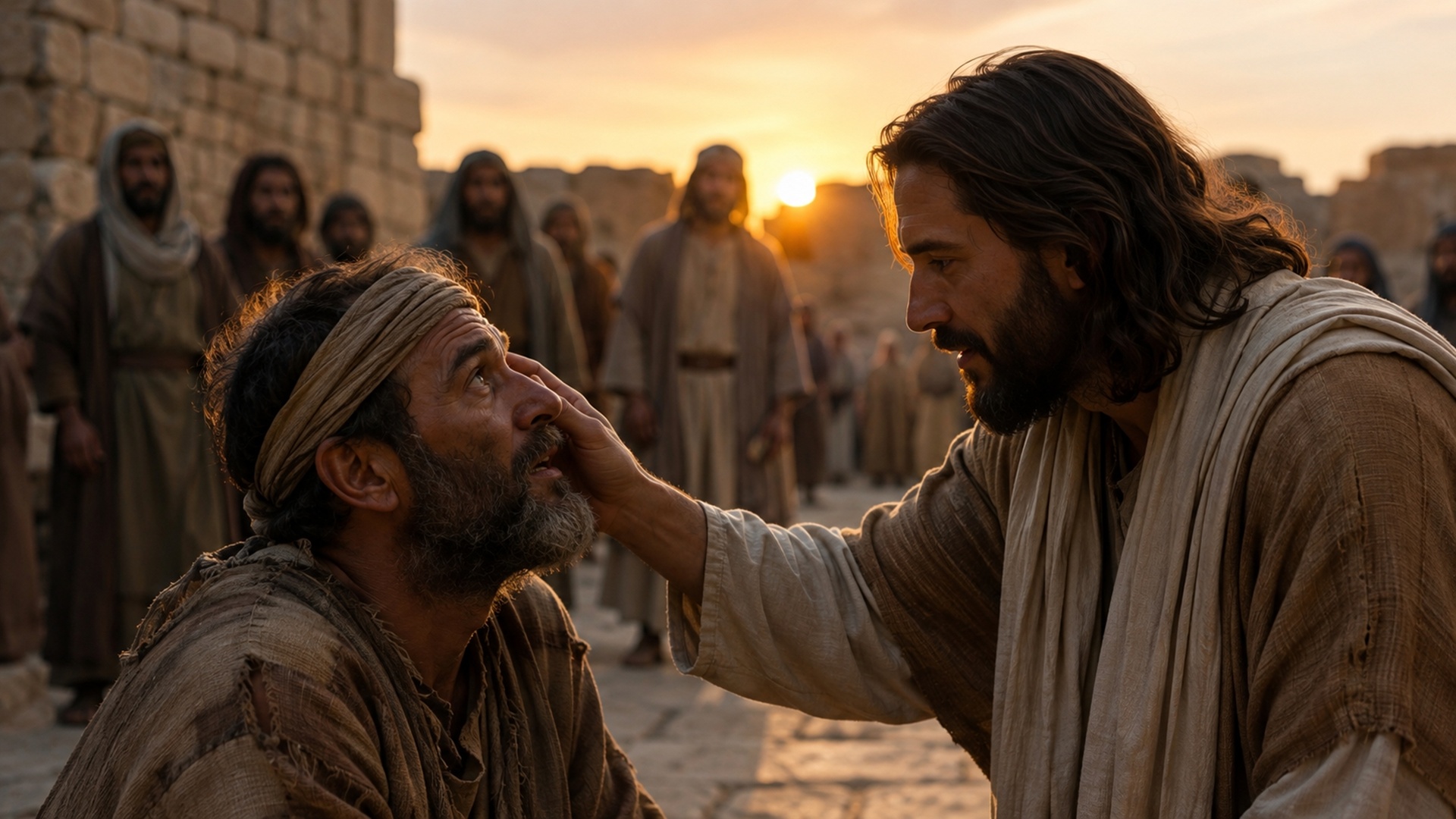
For the man whom John describes in the ninth chapter of his Gospel, there had never been a morning when he had seen the light of the rising sun. He knew the streets of Jerusalem, but not by their colors and shapes. He knew them through sounds, smells, voices, and touch. He heard the footsteps of people on the stones, the calls of merchants, the laughter of children at play, and the voices of pilgrims going up to the temple. Perhaps he could tell from the sound of footsteps whether someone was passing slowly or in a hurry, but he did not know what the face of a person looked like when that person looked kindly at him.
He had not become blind through an accident, nor had he lost his sight sometime during his life. He had been born blind. Darkness was therefore not the memory of something he had lost, but the only world he knew. From personal experience he did not know what color meant, how the sky stretched over Jerusalem, or how the evening light fell upon the walls of the city. He had never even seen the faces of his parents.
Along with his physical blindness came a second burden. In the religious thinking of that time, severe suffering was often directly connected with personal guilt. If a person had been blind from birth, people therefore searched not only for a medical or natural explanation, but for a moral cause. Someone must have sinned. Perhaps the parents, perhaps even the person himself in some way people tried to explain. Thus his suffering became a religious judgment as well.
The man had probably heard such conversations often enough. People passed by him, perhaps placed a coin in his hand, and then discussed why God had allowed such a fate. Others hardly saw him anymore as a person with his own story, but as a problem for which they wanted an explanation. He was the blind man, the beggar, the man by the roadside. His entire identity seemed to be summed up in a single word.
On that day, footsteps approached again. The man could not know that among those passing by was Jesus of Nazareth. Perhaps he had already heard about Him. People in Jerusalem were talking about Jesus, about His words, His healings, and the growing conflict between Him and the religious leaders. Yet even if the blind man knew these reports, he had no reason that morning to think that his own life would become part of such a story.
Then he heard the voice of one of the disciples: “Rabbi, who sinned, this man or his parents, that he was born blind?” The question was not directed to him, but asked about him. Once again his life became the subject of a discussion. But this time someone answered differently from everyone he had heard before.
Jesus said: “Neither this man nor his parents sinned, but this happened so that the works of God might be displayed in him” (John 9:3).
With this answer, Jesus was not saying that the man or his parents had never sinned. Rather, He rejected the idea that his blindness had to be understood as direct punishment for a specific personal sin. The suffering of this man was not to become the basis for a hasty judgment about his relationship with God.
For the first time, the central question was not what lay behind this man, but what God wanted to do in his life.
🌿 Jesus Sees a Person
The first sentence of this story contains a small but decisive detail. John does not merely write that Jesus passed by a blind man. He says: “As Jesus went along, He saw a man.”
There is already an essential difference here between the way Jesus looked at him and the way those around him did. The disciples saw the blindness and searched for an explanation. Jesus saw the person and recognized an opportunity for God’s work. The others looked backward and asked about the cause of his suffering; Jesus looked forward and saw what God’s grace could bring out of this situation.
This way of seeing appears again and again throughout the Gospels. Jesus never reduced people to what had happened to them or to what they had done. To Him, Zacchaeus was not simply “the tax collector,” Mary Magdalene was not merely a woman with a burdened past, Peter was not only the impulsive disciple, and this man was not simply “the man born blind.” Jesus knew the whole truth of their lives and yet always saw the person God had created and whom His grace could reach.
This is deeply important for us because people often look at one another differently. We quickly form judgments based on what is visible. One decision, one mistake, one weakness, or one chapter from the past may be enough for a person to receive a fixed label in our minds. After a while, we no longer see the whole person, but only the characteristic with which we have associated him.
Sometimes the same thing happens in the way we look at our own lives. We view ourselves through the lens of our past and begin to believe that a failure, a wound, or a limitation defines who we are. We remember something that did not succeed and carry that memory with us like a name.
But Jesus sees differently. He knows the past without binding us to it. He knows our weakness without measuring our worth by it. He sees the wounds, but also the healing that is possible. He sees not only our present condition, but also what His grace can bring forth in a person’s life.
That is why this first encounter in the series begins not with a great miracle, but with a look. Even before Jesus opened the man’s eyes, He had done something equally significant: He had seen him.
🔥 When Religious Questions Hide the Person
The disciples’ question was not entirely meaningless. They were trying to understand the relationship between sin and suffering, and the Bible certainly does not deny that sin brought suffering into the world. The problem was rather that a theological truth had become a hasty judgment about a particular person.
They wanted to know who was to blame. Jesus wanted to help.
There is a serious spiritual lesson here. It is possible to speak about God and at the same time overlook the person standing directly in front of us. We can use correct terms, discuss religious questions, and even search for biblical explanations while the heart of the suffering person remains unnoticed.
Jesus refused this attitude. He did not deny the reality of sin, but He did not use the man’s suffering as an occasion for speculation about his guilt. Instead, He redirected attention toward God’s action. The decisive question was no longer: “Why did this person become like this?” but: “What does God want to do now?”
This change of perspective is important for our own lives as well. There are situations whose causes we may never fully understand. Some questions of “why” remain unanswered even after long reflection. Jesus does not promise us an immediate explanation for every form of suffering. But He shows us that an unanswered past does not limit God’s possibilities for the future.
The man born blind could not change his past. He could not go back and be born with healthy eyes. But Jesus was standing before him now. Suddenly, what had been impossible throughout the previous years was no longer the decisive thing. What mattered was what could become possible in that moment through the presence of Christ.
🌙 The Blindness of Those Who See
As John 9 continues, an astonishing reversal becomes increasingly clear. At the beginning of the story, there is a man who is physically blind, surrounded by people who can see. At the end, this man not only sees with his eyes, but increasingly recognizes who Jesus is, while people with perfectly functioning eyes become less and less willing to recognize the truth.
The physical healing thus becomes a picture of a deeper spiritual reality. There is a blindness that does not begin in the eyes, but in the heart. A person may be able to see and still overlook the work of God. He may know Scripture and yet become unable to recognize God’s activity when it does not fit his expectations. He may hold religious convictions and yet fail to look at the person before him with mercy.
The religious leaders later become a particular example of this. They investigate the miracle, question the healed man, question his parents, and search for reasons to reject Jesus. The extraordinary stands directly before them: a man who had been blind from birth can now see. Yet instead of rejoicing, they become increasingly determined to reject the light.
The story therefore does not merely ask whether we are physically able to see. It asks a far more uncomfortable question: What happens when God acts differently from what we expect? Are we willing to let Him correct our thinking, or do we only see what fits our existing picture?
Spiritual blindness often does not begin with knowing nothing about God. It can arise precisely where we believe we already see everything essential and therefore are no longer willing to look again.
🌿 Jesus Acts
After Jesus rejected the false connection between the man’s blindness and a specific personal sin, He did not stop with words. He spat on the ground, made mud with the saliva, put it on the man’s eyes, and said to him: “Go, wash in the Pool of Siloam” – which means “Sent” – (John 9:6–7).
To the blind man, this instruction must have sounded unusual. He had never seen Jesus and still could not observe what He was doing. He had no visible guarantee that anything would change. He had only heard the words of a man who had spoken about him differently from everyone else and who now told him to take a particular path.
John then reports with remarkable simplicity: “So the man went and washed, and came home seeing.”
Between those two sentences lies a journey of trust. The man had to set out while he was still blind. Every step toward the pool was taken before the result became visible. He obeyed not because he could already see, but because he trusted Jesus’ word enough to begin walking.
This is an essential element of faith. We often want certainty first and action afterward. We want to see that the way will work before we walk it. But in our encounter with Christ, the order is often reversed. His word calls us to trust, and some things become visible only along the way.
The man went blind to the pool.
But he returned seeing.
And with that began the second, and perhaps even deeper, part of his encounter with Jesus. Christ wanted to give him more than physical sight. He wanted to lead him from darkness to light, from experiencing a miracle to recognizing the Savior, and finally to personal faith.
And this very journey will show that people can have open eyes and still be blind – and that a man who had never seen anything throughout his entire life would ultimately see more clearly than many who considered themselves sighted.
🕊️ A Story – When the Man Who Could See Became a Witness
The man returned from the Pool of Siloam and could see. With a single sentence, the Gospel of John describes something that turned his entire previous life upside down. For the first time, he could not only hear the streets of Jerusalem, but see them. Faces, houses, trees, sky, light, and shadow suddenly became reality for him. People whose voices he had known for years now had faces. The world he had previously known only through touch and sound opened before his eyes.
Yet surprisingly, John tells us almost nothing about the joy of that moment. Instead, he immediately leads us to the reactions of the people. The neighbors and those who had formerly seen the man begging were not even sure whether he was really the same person. Some said, “He is the one,” while others said, “No, he only looks like him.” Finally, the healed man himself had to say, “I am the man” (John 9:9).
This began a series of interrogations that increasingly revealed that the miracle had not only opened one man’s eyes, but also exposed what was happening in the hearts of others. The people wanted to know how it had happened, and the man simply told them what he knew: Jesus had made mud, put it on his eyes, and sent him to the Pool of Siloam. He had gone, washed, and since then he had been able to see.
At first, he could say no more than that. When asked where Jesus was, he answered: “I don’t know.” He had experienced the miracle, but he had not yet truly come to know the One who had performed it. There is something very beautiful in this part of the story: his understanding grows step by step. Jesus does not demand that he understand everything at the beginning. The man starts with what he has experienced, and throughout the events he increasingly comes to understand who Christ is.
🔥 A Miracle on the Sabbath
Then John mentions a detail that becomes decisive for everything that follows: Jesus had healed the man on the Sabbath. That circumstance transformed the joy over the miracle into a religious conflict. The healed man was brought to the Pharisees, and they too wanted to know how he had received his sight.
The man again explained what had happened. But instead of recognizing in his healing a sign of divine power, some of the Pharisees focused on the fact that Jesus had made mud on the Sabbath and, according to their interpretation, had therefore broken the Sabbath regulations. Some said: “This man is not from God, for He does not keep the Sabbath.” Others asked: “How can a sinner perform such signs?” (John 9:16).
In the middle of this dispute stood a man who had been blind that morning and could now see.
The miracle was impossible to overlook, yet preconceived opinion was stronger than joy over what had happened. Instead of asking what God had done, they tried to fit the event into their existing religious framework. Because Jesus did not act as they expected, even an obvious work of healing came under suspicion.
Here the spiritual blindness that Jesus later addresses openly becomes visible. It was not a lack of information that hindered these men. The sign stood directly before them. Their problem was that they were not willing to let their concept of God be corrected by what God was actually doing.
Ellen G. White emphasizes this very contrast in her account of the healing of the man born blind: through an act of mercy, Christ had revealed the true meaning of the Sabbath, while His opponents had burdened the holy day with so many human regulations that they saw in a healing more of a violation of rules than a work of God. For Jesus, the Sabbath was never opposed to mercy and restoration. Precisely on this day, it was meant to become visible how God meets human beings.
(See Ellen G. White, The Desire of Ages, section on the healing of the man born blind and Jesus’ controversies over the Sabbath.)
🌿 “One Thing I Know”
The Pharisees continued questioning the man. They wanted to know what he himself thought about Jesus. His answer showed that his understanding had already grown: “He is a prophet” (John 9:17).
That was not enough for them. They now even doubted that he had truly been born blind and called in his parents. They confirmed that he was their son and that he had been born blind. But when they were asked how he could now see, they avoided answering. John explains that they were afraid of the religious leaders, because it had already been decided that anyone who confessed Jesus as the Christ would be put out of the synagogue.
The healed man was therefore increasingly left alone. His parents did not want to defend him, the religious leaders put him under pressure, and the reality of his healing became the center of a conflict he had never sought.
Finally, they called him again and demanded that he give glory to God, because they claimed to know that Jesus was a sinner.
He answered with a sentence that has become one of the most powerful personal testimonies in the Gospel of John:
“Whether He is a sinner or not, I don’t know. One thing I do know. I was blind, but now I see!”
(John 9:25)
He did not try to answer every theological question. He did not pretend to know more than he knew. But there was one thing no one could take away from him: his own experience.
That morning he had not been able to see.
Now he could see.
People could argue about how Jesus should be understood. They could question His authority or try to reinterpret the miracle. But they could not undo the reality of a transformed life.
There is a lasting lesson for faith here. A Christian does not need to have an immediate answer to every question. There will be situations in which our knowledge is limited and we understand some things only later. Yet we may honestly speak about what Christ has done in our lives. Personal testimony does not replace the truth of Scripture, but it makes visible that this truth can truly touch a human life.
🌙 The Cost of a Clear Confession
The longer the conversation continued, the more courageous the man became. The Pharisees again asked what Jesus had done, and eventually he pointed out the contradiction in their attitude. They kept asking how the miracle had happened, yet at the same time they were determined to reject the One who had performed it.
The formerly blind man now began to ask questions himself. In essence, he said that it was remarkable: they claimed not to know where Jesus came from, even though He had opened his eyes. God does not listen to a person who deliberately lives against Him, but to one who honors Him and does His will. Never since the world began had anyone heard of opening the eyes of a man born blind. If this man were not from God, He could do nothing (see John 9:30–33).
The man who at first could only say, “The man they call Jesus,” later confessed, “He is a prophet,” and now publicly defended the conviction that Jesus must have come from God. While the religious leaders, despite all their knowledge, became less and less willing to see, the formerly blind man became more and more seeing with every step – not only physically, but spiritually.
His openness, however, came at a price. The leaders insulted him and threw him out.
The man had received his sight, but suddenly he may have lost an important part of his social and religious belonging. His encounter with Jesus had not simply made his life easier. The light he had received also led him into a decision.
Yet precisely where people cast him out begins one of the most moving sections of the entire story.
❤️ Jesus Seeks Him a Second Time
John writes:
“Jesus heard that they had thrown him out, and when He found him, He said, ‘Do you believe in the Son of Man?’”
(John 9:35)
These few words deserve attention: Jesus found him.
At the beginning of the story, Jesus had seen the blind man even though the man could not see Him. Now, after the man had been cast out because of his testimony, Jesus sought him again.
Christ had not merely given him sight and then left him on his own. He knew what the healing had set in motion. He knew about the questioning, the pressure, and the rejection. And He came to him again.
The man asked: “Who is He, sir, that I may believe in Him?” Jesus answered: “You have now seen Him; in fact, He is the One speaking with you” (John 9:36–37).
How deeply these words must have sounded to a man who had spent his entire life blind:
“You have now seen Him.”
The face of Jesus now belonged to the faces this man was able to see. But Christ led him further still. It was not merely about seeing Jesus with physical eyes. He was to recognize who stood before him.
Then the man answered:
“Lord, I believe.”
And he worshiped Him.
This is where the healing is completed. Not at the Pool of Siloam, but here.
At the pool, his eyes were opened.
Now his heart was opened.
The greatest gift in this story was not that a blind man could see the world. The greatest gift was that a man recognized Christ.
🌾 The Sabbath – a Day When Christ Teaches Us to See Anew
The fact that Jesus healed the man born blind specifically on the Sabbath is not a minor detail in this story. The conflict that followed shows how differently the Sabbath can be understood. For Jesus’ opponents, it had increasingly become a system that had to be protected by numerous human regulations. For Jesus, the Sabbath remained what God had created it to be: a holy space for fellowship with God, liberation, mercy, and the restoration of human beings.
The healed man became on that Sabbath a living testimony that God’s rest does not mean indifference toward human suffering. God does not rest from His love. The Creator who at the beginning spoke light into the darkness met on that Sabbath a man who had never seen light and opened his eyes. The healing therefore did not fit the Sabbath less; rather, it revealed something of its deepest meaning.
For us too, the Sabbath can become a day when Christ opens our eyes anew. During the week, we see many things only in passing. Tasks, appointments, news, worries, and obligations demand our attention. We function, react, and plan, and sometimes we hardly notice how narrow our perspective has become. We mainly see what is urgent and lose sight of what truly matters.
Then the Sabbath comes and interrupts this rhythm. God gives us time in which we do not constantly have to produce, achieve, or prove ourselves. This rest creates space for another way of seeing. We can look back and discover where God carried us through the past week. We can become more aware again of people who have easily become taken for granted in everyday life. We can read Scripture without already thinking about the next task, and we can allow God to reveal our own blind spots.
Perhaps sometimes we are like the disciples at the beginning of the story. We see a person, but our thoughts first turn toward explanations and judgments. The Sabbath can teach us to look more slowly and ask: How does Jesus see this person? Perhaps someone near us is carrying a struggle we know nothing about. Perhaps we have long reduced someone to a mistake, a trait, or a past. Christ wants to correct our vision so that we see not only problems, but people.
On other Sabbaths, perhaps we resemble the religious leaders more. We know the meaning of the Sabbath, care about its holiness, and want to be faithful to God – and precisely for that reason this story must ask us whether our understanding of the Sabbath also reflects the heart of Jesus. A Sabbath that separates us from work but does not make us more merciful has not yet fully reached its purpose. If after the Sabbath we judge the same people just as harshly as before, overlook the same suffering, and carry the same self-righteousness with us, then our spiritual eyes also need healing.
Jesus shows in John 9 that Sabbathkeeping and mercy are not opposites. Precisely because the Sabbath belongs to God, it also belongs among the special times when God’s healing character should become visible. It creates space for visiting someone who is lonely, for a reconciling conversation, for attentive listening, for praying together, for comfort, and for the simple willingness to truly notice another person.
Perhaps, however, we ourselves are the man born blind. Then the message of this Sabbath is not first that we should see better, but that we are seen. Even before we fully recognize God, He has recognized us. Even before we find words for our need, Christ knows it. Even before we know what our next step should be, His eyes are already upon us.
The man born blind did not first need to be able to see in order to be seen by Jesus.
The same is true for us.
Therefore, on the Sabbath we may become still before Christ and pray: “Lord, show me what I still do not see.” Perhaps He will not answer every question. Perhaps not every difficult situation will change immediately. But He can change the way we see. And sometimes that is precisely the beginning of a much deeper transformation.
Week after week, the Sabbath invites us out of the darkness of our limited perspective into the light of God’s presence. It reminds us of the Creator who can create light where there was darkness before, and of Christ who does not pass us by. In this way, every Sabbath can become a small repetition of this encounter: Jesus sees us, speaks to us, leads us – and step by step opens our eyes.
🤲 Invitation
Take some intentional time this Sabbath to ask Christ one simple question: “Lord, what am I still not seeing?” Perhaps you want to recognize His work in your own life anew, perhaps to look at another person with different eyes, or perhaps to let go of an attitude that has narrowed your vision.
Do not ask Him only to change the things around you. Ask Him also to change the way you see. The man in John 9 returned from the pool seeing, but his deepest understanding grew only along the further journey. Christ can patiently walk with us in the same way, step by step, until an initial recognition becomes a personal confession: “Lord, I believe.”
✨ Prayer
Lord Jesus, You did not pass by the blind man, but saw him before he could see You. You also know me completely. You see what occupies my thoughts, what I do not understand, and what sometimes darkens my vision. Therefore I ask You on this Sabbath: Open my eyes to Your presence and teach me to look at my life and the people around me through Your eyes.
Keep me from judging too quickly where You want to act with mercy. Show me my spiritual blind spots and give me a heart that is willing to be corrected by You. Let the Sabbath become for me not merely a break from work, but a real encounter with You, in which my thoughts become quieter, my vision clearer, and my heart more receptive to Your voice.
And when I do not understand the path You are leading me on, give me the trust of the man who set out at Your word even though he still could not see. Lead me step by step out of my limited perspective into Your light, until my heart too recognizes You more and more clearly and can say with deepest conviction: Lord, I believe.
Amen.
