


🌍 WHEN THE WORLD IS APPROACHING ITS END
🕯️ Hope, Watchfulness, and Faithfulness in Matthew 24–25
Sermon 1: 🪨 When Not One Stone Is Left Upon Another
Earthly securities and the unshakable kingdom of God
Main Text: Matthew 24:1–3
Key Verse: Hebrews 12:28
Sermon Thought: Everything earthly can be shaken. But whoever builds on Christ and His Word belongs to a kingdom that will never pass away.
Welcome and Introduction
Dear congregation,
today we begin our sermon series on Matthew 24 and 25. In these two chapters, Jesus speaks about the future of Jerusalem, the course of world history, signs and deceptions, watchfulness and readiness, faithfulness and responsibility, and finally about His glorious second coming.
These words of Jesus are serious, but they were not spoken to fill us with fear. Jesus does not want to turn us into sensation-seeking observers who suspect the next prophetic event behind every headline. He wants to prepare people who will remain standing even when familiar things collapse.
The Olivet Discourse does not begin with a distant gaze into the sky, but with a building. The disciples point out the temple to Jesus. They see its greatness, beauty, and apparent indestructibility. Jesus, however, already sees the day when nothing of this glory will remain but ruins.
Before we open Matthew 24, I would like to take us into that time through a narrative illustration.
The Stone in His Hand
The following story is a narrative illustration based on the events surrounding the destruction of Jerusalem.
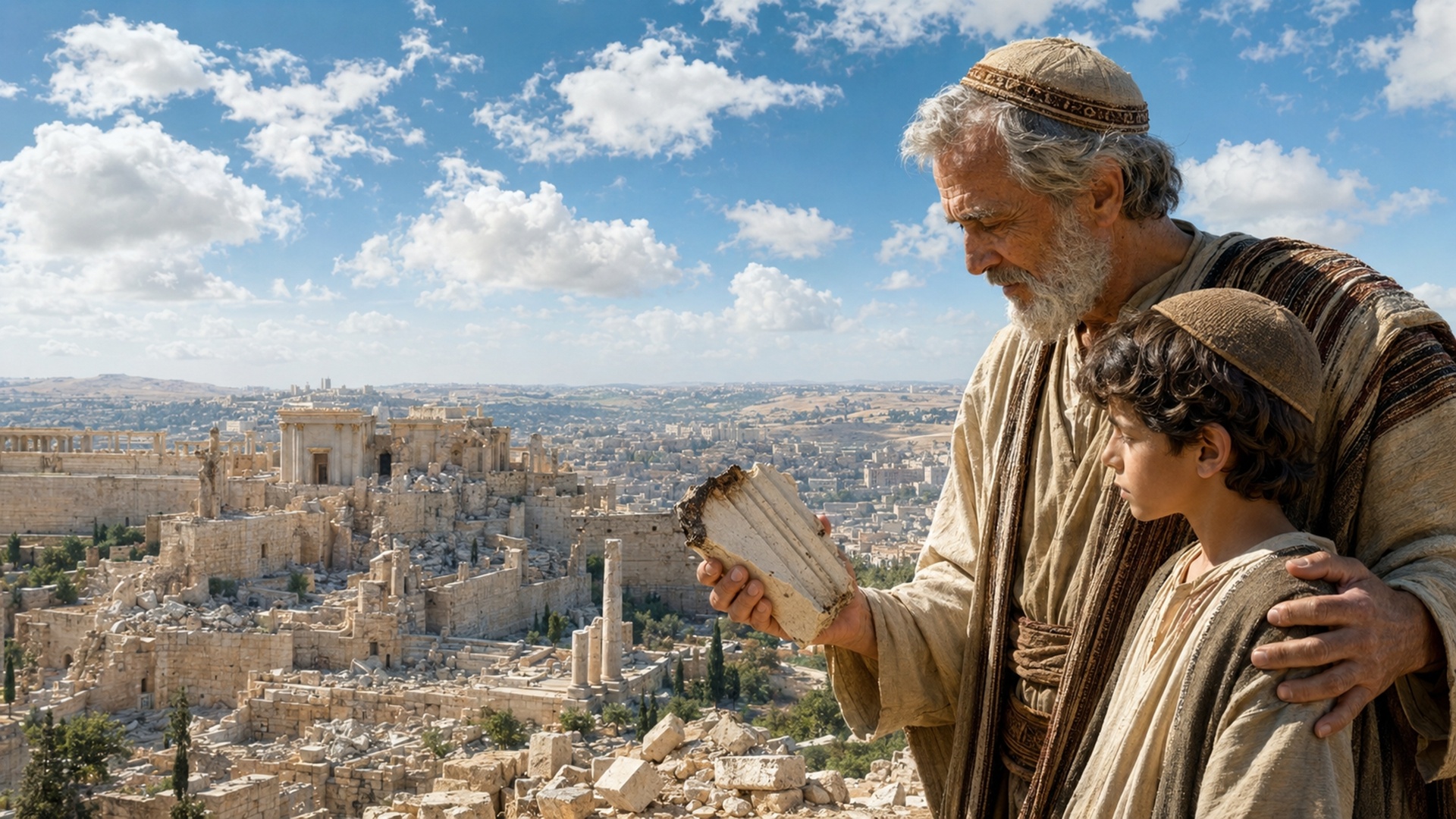
The old man stood silently on the hill. Below him lay Jerusalem – or what was left of Jerusalem. Where mighty walls had once risen, broken stones now lay scattered. Houses had collapsed, gates had burned, and entire streets were buried beneath rubble. The smell of smoke still hung over the ruins.
The hardest sight for the old man to bear was the Temple Mount. For decades, the temple had shone over the city. Its white marble stones had reflected the sunlight. Its golden decorations had been visible from afar. Pilgrims had stopped as soon as they saw it and had prayed to God with reverence.
Now almost nothing remained.
The man’s name was Eliakim. As a young man, he himself had worked at the temple. He had seen the enormous stone blocks and had run his hands over their smooth surfaces. At that time, an older builder had once said to him: “Look at these stones, Eliakim. As long as these walls stand, Jerusalem will never fall.”
Eliakim had believed him. Who could have destroyed such walls? Who would have dared to touch God’s temple? For Eliakim, the temple had been more than a building. It was the visible sign that God dwelt among His people. As long as the temple stood, he had thought, nothing could happen to them.
Now part of those seemingly indestructible stones lay at his feet.
Eliakim bent down and picked up a broken piece of white marble. It was heavy. One side was still smooth, the other blackened by fire.
His grandson Jonathan, who stood beside him, looked up at him.
“Grandfather,” the boy asked quietly, “was that really once part of the temple?”
Eliakim nodded.
“Yes. Perhaps this stone belonged to a wall. Perhaps to a column. I do not know.”
Jonathan looked over the destroyed city.
“You always said the temple was the most beautiful building in the world.”
“It was.”
“Then why did God allow it to be destroyed?”
Eliakim did not answer immediately. The boy’s question struck him deeply. It was a question that had troubled him as well. After a while, he sat down on a larger stone. Jonathan sat beside him.
“Many years before you were born,” Eliakim began, “I heard about a Teacher from Galilee. His name was Jesus.”
The boy knew that name. His parents had told him about Jesus. But he remained silent and listened carefully.
“Jesus was standing with His disciples in front of the temple,” Eliakim continued. “The disciples pointed out the mighty buildings and the enormous stones. They were just as impressed as all of us were.”
Eliakim looked again at the ruins.
“But Jesus said something that no one wanted to believe at the time.”
“What did He say?” Jonathan asked.
The old man held the piece of marble in his hand and answered:
“Do you not see all these things? Truly I tell you, not one stone here will be left on another; every one will be thrown down.”
Jonathan looked at the stone in his grandfather’s hand.
“And it really happened.”
“Yes,” Eliakim said. “Exactly as Jesus had predicted.”
“Did you believe Him then?”
Eliakim lowered his eyes.
“No. I thought it was impossible. I trusted the walls. I trusted the greatness of the city. I trusted what my eyes could see.”
The boy waited while the old man searched for words.
“Some followers of Jesus,” Eliakim continued, “took His warning seriously. They remembered His words. When the Roman armies came and then withdrew for a short time, they left the city. Many people mocked them. They were called cowards and traitors.”
“But they were saved,” Jonathan said.
“Yes. They were saved because they trusted the word of Jesus more than their eyes.”
The wind moved across the hill and stirred dust among the broken stones.
Jonathan pointed to the piece of marble.
“Then that stone was not as strong as people thought.”
Eliakim looked at it for a long time.
“No. It was strong. But it was not eternal.”
The old man slowly let the stone fall to the ground. It struck the rubble with a dull sound.
“That is the lesson I learned very late, Jonathan: Everything people build can fall.”
He pointed toward the city.
“Walls can fall. Temples can be destroyed. Empires can collapse. Possessions can be lost. People we depend on can disappoint us. Even our own lives can change from one day to the next.”
Jonathan moved closer to his grandfather.
“Then is there anything at all that is safe?”
Eliakim put his arm around the boy.
“Yes. There is a Rock that never falls.”
“What Rock?”
“Jesus.”
The old man looked into his grandson’s eyes.
“It took me many years to understand that. Jesus had not only predicted the destruction. He had also told people where they could find security.”
Eliakim quoted words he had since learned by heart:
“Therefore everyone who hears these words of Mine and puts them into practice is like a wise man who built his house on the rock. The rain came down, the streams rose, and the winds blew and beat against that house; yet it did not fall, because it had its foundation on the rock.”
Matthew 7:24–25
“So the disciples of Jesus were saved because they had built on the Rock?” Jonathan asked.
“Yes. They heard His words – and they acted on them.”
Eliakim looked once more at Jerusalem.
“Many people knew the temple. They admired its stones. They attended the services. But when Jesus spoke to them, they did not want to listen. They trusted the building more than the Lord of the temple.”
Jonathan thought for a while.
Then he asked:
“Grandfather, what are we building our house on?”
The old man smiled sadly, but there was hope in his eyes.
“Not on these stones,” he answered, pointing toward the ruins. “We are building on the Word of Jesus.”
The two sat on the hill for a long time. Before them lay a destroyed city. Behind them were years filled with fear, flight, and loss. Yet in the middle of the ruins, something had arisen that no Roman army could destroy: a trust no longer resting on visible walls.
Finally Eliakim stood and held out his hand to his grandson.
“Come,” he said. “We are going home.”
Jonathan looked around.
“But where is our home now?”
Eliakim looked toward heaven.
“Wherever Christ is with us.”
Then they walked down the hill together. Behind them lay the broken piece of marble – a silent witness that even the mightiest works of human beings pass away.
But the words of Jesus remained.
1. What the Disciples Saw – and What Jesus Saw
This story takes us back to the moment when Jesus left the temple with His disciples. The disciples saw enormous stones and what appeared to be an unshakable future. Jesus, however, saw what no human being could see.
We read Matthew 24:1–2:
“Jesus left the temple and was walking away when His disciples came up to Him to call His attention to its buildings. ‘Do you see all these things?’ He asked. ‘Truly I tell you, not one stone here will be left on another; every one will be thrown down.’
Matthew 24:1–2
Mark tells us how impressed the disciples were:
“As Jesus was leaving the temple, one of His disciples said to Him, ‘Look, Teacher! What massive stones! What magnificent buildings!’
Mark 13:1
In these words we hear genuine amazement. The temple was the religious center of the people, a national symbol, and one of the most impressive buildings of the ancient world. Some of its stones were of extraordinary size. White marble, golden decorations, and massive walls gave the impression that the structure would stand forever.
But Jesus was not blinded by the brilliance of the facade. He saw not only what the temple looked like at that moment. He also saw where the spiritual development of the nation would lead.
Only moments earlier, He had lamented over Jerusalem:
“Jerusalem, Jerusalem, you who kill the prophets and stone those sent to you, how often I have longed to gather your children together, as a hen gathers her chicks under her wings, and you were not willing! Look, your house is left to you desolate.”
Matthew 23:37–38
Jesus did not rejoice over the coming judgment. He did not speak coldly about the destruction of the city. Luke reports:
“As He approached Jerusalem and saw the city, He wept over it and said, ‘If you, even you, had only known on this day what would bring you peace – but now it is hidden from your eyes.’”
Luke 19:41–42
The One who announced Jerusalem’s destruction wept over Jerusalem. Prophetic preaching without the heart of Jesus becomes hard, proud, and cold. Jesus spoke about judgment, but He spoke with tears. He warned because He wanted to save.
Ellen White describes the sight of Jesus looking upon Jerusalem with these words:
“The Majesty of heaven in tears! The Son of the infinite God troubled in spirit, bowed down with anguish!”
She emphasizes that Christ saw not only the city, but also the consequences of sin and the suffering of all humanity before Him. Ellen G. White, The Great Controversy, Chapter 1: “The Destruction of Jerusalem”
Therefore, whenever we speak about Matthew 24, we must never forget who is speaking. It is not a sensation-seeking prophet who takes pleasure in the downfall of the world. It is the Savior who weeps over a lost city.
2. The Danger of False Security
Why were the words of Jesus so shocking to the disciples? Because the temple was not merely a building to them. It was part of their spiritual security.
The people believed: God’s house stands here; therefore nothing can happen to Jerusalem. A similar attitude had already existed in the days of Jeremiah. At that time God said:
“Do not trust in deceptive words and say, ‘The temple of the LORD, the temple of the LORD, the temple of the LORD!’ If you really change your ways and your actions…”
Jeremiah 7:4–5
The people trusted in the temple while disregarding God’s will. They treated the visible sign of God’s presence like a guarantee that would remain valid regardless of their relationship with Him.
But a holy building cannot protect an unholy way of life. Religious tradition cannot replace a living relationship with God. Belonging to a church is valuable, but it does not save us without Christ. Knowledge of prophetic truth is a gift, but it cannot replace personal obedience.
Jesus said to the religious leaders:
“You search the Scriptures because you think that in them you have eternal life; and these are the very Scriptures that testify about Me, yet you refuse to come to Me to have life.”
John 5:39–40
They knew the Scriptures, but rejected the One to whom the Scriptures pointed. They loved the temple, but rejected the Lord of the temple.
We too can rely on things that are good and valuable but must never become our foundation. We may rely on our church tradition, our Bible knowledge, our experience, our position, our family, or our past faithfulness. But Paul warns:
“Therefore let him who thinks he stands take heed lest he fall.”
1 Corinthians 10:12
Our security does not lie in how long we have believed. It does not lie in how many sermons we have heard or how many prophetic connections we understand. Our security lies in Christ alone.
Paul writes:
“For no one can lay any foundation other than the one already laid, which is Jesus Christ.”
1 Corinthians 3:11
Everything else can be shaken. Christ remains.
3. God Does Not Dwell in Stones, but Among His People
The temple had a God-given purpose. It reminded Israel of God’s presence, sacrifice, forgiveness, and the coming Messiah. But the temple was never intended to replace God.
Solomon already recognized this at the dedication of the first temple:
“But will God really dwell on earth with humans? The heavens, even the highest heavens, cannot contain You. How much less this temple I have built!”
2 Chronicles 6:18
God allowed His glory to become visible in the temple, but He was not confined within a building. When Jesus came, the true Temple of God stood in the midst of the people.
John writes:
“The Word became flesh and dwelt among us. We have seen His glory, the glory of the one and only Son, who came from the Father, full of grace and truth.”
John 1:14
Jesus said about Himself:
“Destroy this temple, and I will raise it again in three days.”
John 2:19
John explains:
“But the temple He had spoken of was His body.”
John 2:21
The earthly temple could be destroyed. Christ was crucified, but on the third day He rose from the grave. In this way God showed that His presence, His plan of salvation, and His kingdom do not depend on a human building.
After the resurrection and ascension of Jesus, the church became the temple of the Holy Spirit. Paul writes:
“Do you not know that you are God’s temple and that God’s Spirit dwells among you?”
1 Corinthians 3:16
And Peter says:
“You also, like living stones, are being built into a spiritual house to be a holy priesthood, offering spiritual sacrifices acceptable to God through Jesus Christ.”
1 Peter 2:5
God’s work does not depend on marble stones. His church consists of living stones – people in whom Christ dwells.
Church buildings can be closed, damaged, or destroyed. Institutions can be shaken. Structures can change. But as long as people hold on to Christ, pray, proclaim His Word, and serve one another, God’s church lives.
Jesus says:
“For where two or three gather in My name, there am I with them.”
Matthew 18:20
The true wealth of a congregation therefore does not lie first in its building, technology, program, or social standing. Its greatest treasure is the presence of Jesus.
4. What Happens When Our Securities Collapse?
Jesus’ words about the temple also confront us with a personal question: What happens to our faith when something we have depended on suddenly collapses?
Some people build their security on possessions. Jesus tells of a rich man whose fields produced an abundant harvest. The man said:
“I will tear down my barns and build bigger ones, and there I will store my surplus grain. And I’ll say to myself, ‘You have plenty of grain laid up for many years. Take life easy; eat, drink and be merry.’”
Luke 12:18–19
But God replied:
“You fool! This very night your life will be demanded from you. Then who will get what you have prepared for yourself?”
Luke 12:20
The man’s problem was not that his fields had produced well. His problem was that his possessions had become his foundation. His barns were full, but his soul was empty.
Others build on their health. Yet a single diagnosis can change an entire life. Some build on their profession until a dismissal shakes their identity. Some build on human relationships until they are disappointed or abandoned. Others build on political stability, economic progress, or the supposed security of society.
The Bible does not forbid us to plan responsibly. But it warns us not to make temporary things our ultimate support.
David writes:
“Some trust in chariots and some in horses, but we trust in the name of the LORD our God. They are brought to their knees and fall, but we rise up and stand firm.”
Psalm 20:7–8
And the prophet Jeremiah says:
“Cursed is the one who trusts in man, who draws strength from mere flesh and whose heart turns away from the LORD. But blessed is the one who trusts in the LORD, whose confidence is in Him.”
Jeremiah 17:5, 7
It is possible that God may allow certain securities to be shaken so that we recognize what we have truly built upon. This does not mean that every suffering is a direct punishment from God. But God can use even difficult experiences to draw us closer to Himself.
Paul speaks of such an experience:
“We do not want you to be uninformed, brothers and sisters, about the troubles we experienced in the province of Asia. We were under great pressure, far beyond our ability to endure, so that we despaired of life itself. Indeed, we felt we had received the sentence of death. But this happened that we might not rely on ourselves but on God, who raises the dead.”
2 Corinthians 1:8–9
Paul came to the end of his own strength. There he learned not to trust in himself, but in the God who raises the dead.
Perhaps you are asking today: Why did God allow something in my life to collapse? Why was a door closed? Why did a relationship not endure? Why did a hope break apart?
We will not receive an immediate answer to every question. But we may know this: When our visible securities fall, Christ does not fall.
5. The House on the Rock
At the end of the Sermon on the Mount, Jesus tells of two men. Both built a house. Both experienced the same storm. The decisive difference was not the beauty of the house, but its foundation.
Jesus says:
“Therefore everyone who hears these words of Mine and puts them into practice is like a wise man who built his house on the rock. The rain came down, the streams rose, and the winds blew and beat against that house; yet it did not fall, because it had its foundation on the rock.”
Matthew 7:24–25
Then Jesus describes the second house:
“But everyone who hears these words of Mine and does not put them into practice is like a foolish man who built his house on sand. The rain came down, the streams rose, and the winds blew and beat against that house, and it fell with a great crash.”
Matthew 7:26–27
Both men heard the words of Jesus. The difference was not between someone who knew the Bible and someone who had never heard of God. Both heard. But only one acted upon what he heard.
Building on Christ therefore means more than intellectually agreeing with correct doctrines. It means obeying His Word.
When Jesus says, “Forgive,” I build on the Rock by forgiving.
When Jesus says, “Seek first the kingdom of God,” I build on the Rock by reordering my priorities.
When Jesus says, “Love your enemies,” I build on the Rock by refusing to nurture hatred and revenge.
When God says, “Remember the Sabbath day, to keep it holy,” I build on the Rock by trusting His command.
When Jesus says, “Watch,” I build on the Rock by remaining spiritually awake.
The storm does not first reveal what foundation we need. It reveals what foundation we have already chosen. Therefore, preparation for future crises does not begin only when the crisis arrives. It begins today in the seemingly small decisions of faith.
“Whoever can be trusted with very little can also be trusted with much.”
Luke 16:10
6. A Kingdom That Cannot Be Shaken
The destruction of Jerusalem shows us that even impressive religious and political systems can fall. But the Bible speaks of a kingdom that will never pass away.
Daniel saw in vision the successive kingdoms of world history. Babylon, Medo-Persia, Greece, and Rome came and went. Then he saw another kingdom:
“In the time of those kings, the God of heaven will set up a kingdom that will never be destroyed, nor will it be left to another people. It will crush all those kingdoms and bring them to an end, but it will itself endure forever.”
Daniel 2:44
The kingdoms of this world arise, reach the height of their power, and disappear. Borders change, governments change, systems collapse. But the kingdom of God remains.
Hebrews 12 describes a final great shaking:
“At that time His voice shook the earth, but now He has promised, ‘Once more I will shake not only the earth but also the heavens.’ The words ‘once more’ indicate the removing of what can be shaken – that is, created things – so that what cannot be shaken may remain.”
Hebrews 12:26–27
Then comes our key verse:
“Therefore, since we are receiving a kingdom that cannot be shaken, let us be thankful, and so worship God acceptably with reverence and awe.”
Hebrews 12:28
We are receiving an unshakable kingdom. This does not mean that Christians will never experience shaking. It means that the shaking will not have the final word over us.
Paul writes:
“We are hard pressed on every side, but not crushed; perplexed, but not in despair; persecuted, but not abandoned; struck down, but not destroyed.”
2 Corinthians 4:8–9
Why are we not destroyed? Because our life is hidden with Christ.
“For you died, and your life is now hidden with Christ in God.”
Colossians 3:3
Our possessions may be lost, but our inheritance in heaven remains. Our bodies may become weak, but the inner person can be renewed. People may reject us, but Christ does not abandon us. Even death cannot separate us from His love.
“For I am convinced that neither death nor life, neither angels nor demons, neither the present nor the future, nor any powers, neither height nor depth, nor anything else in all creation, will be able to separate us from the love of God that is in Christ Jesus our Lord.”
Romans 8:38–39
This is the Christian’s security. Not the absence of shaking, but the indestructible presence of Christ.
7. From the Destruction of Jerusalem to the End of the World
After Jesus announced the destruction of the temple, the disciples went with Him to the Mount of Olives.
“As Jesus was sitting on the Mount of Olives, the disciples came to Him privately. ‘Tell us,’ they said, ‘when will this happen, and what will be the sign of Your coming and of the end of the age?’”
Matthew 24:3
In their question, they connected the destruction of Jerusalem with the second coming of Jesus and the end of the world. Jesus answered in such a way that His words included both the events of their own time and the developments reaching to the end of the world.
Ellen White explains:
“The prophecy which He uttered was twofold in its meaning.”
It referred to the destruction of Jerusalem and at the same time pointed forward to the events preceding the second coming. Ellen G. White, The Great Controversy, Chapter 1
Jerusalem therefore became a warning example. The city possessed great religious privileges, but its inhabitants rejected the voice of Jesus. They had the temple, but rejected the Messiah. They held on to outward forms while rejecting the inward call to repentance.
Before the end of the world, people will also trust visible securities more than the Word of God. Jesus warns:
“For in the days before the flood, people were eating and drinking, marrying and giving in marriage, up to the day Noah entered the ark; and they knew nothing about what would happen until the flood came and took them all away. That is how it will be at the coming of the Son of Man.”
Matthew 24:38–39
Eating, drinking, and marrying were not sinful. The problem was that people were completely absorbed in everyday life and ignored God’s warning. They lived as though the present world would last forever.
Peter reminds us:
“The end of all things is near. Therefore be alert and of sober mind so that you may pray.”
1 Peter 4:7
The right response to prophetic knowledge is not panic, but sobriety and prayer. Paul says:
“So then, let us not be like others, who are asleep, but let us be awake and sober.”
1 Thessalonians 5:6
Matthew 24 should not cause us to stare anxiously at the world all the time. It should move us to look more faithfully to Jesus.
8. We Are Not Merely Waiting for an Event – We Are Waiting for Our Lord
Christian hope is not directed only toward the end of an old world. It is directed toward the return of a Person.
Jesus says:
“And if I go and prepare a place for you, I will come back and take you to be with Me that you also may be where I am.”
John 14:3
Notice the personal language of Jesus: “I will come back. I will take you to be with Me. You will be where I am.”
We are not merely waiting for a prophetic chart to be fulfilled.
We are waiting for Jesus.
We are not merely waiting for an event. We are waiting for our Lord.
Paul writes:
“For the Lord Himself will come down from heaven, with a loud command, with the voice of the archangel and with the trumpet call of God, and the dead in Christ will rise first. After that, we who are still alive and are left will be caught up together with them in the clouds to meet the Lord in the air. And so we will be with the Lord forever.”
1 Thessalonians 4:16–17
The center of this passage is not the trumpet, the clouds, or dramatic events. Its center is:
“And so we will be with the Lord forever.”
That is our hope. Jesus is coming to take His people to Himself.
Matthew 24 describes shaking, wars, famines, persecution, and deception. But the chapter does not end in darkness. Jesus says:
“Then will appear the sign of the Son of Man in heaven. And then all the peoples of the earth will mourn when they see the Son of Man coming on the clouds of heaven, with power and great glory. And He will send His angels with a loud trumpet call, and they will gather His elect from the four winds.”
Matthew 24:30–31
World history is not moving toward chaos as its final destination, but toward the return of the King. Evil will not have the final word. Christ will come, raise the dead, gather His people, and establish His eternal kingdom visibly.
Therefore Jesus says:
“When these things begin to take place, stand up and lift up your heads, because your redemption is drawing near.”
Luke 21:28
9. What Remains When Everything Else Falls?
Dear congregation, perhaps we too regard certain things as unshakable: our houses, savings, health, professional position, social order, or even our religious institutions.
We look at them and think: This will remain.
But Jesus does not ask us today how impressive our house looks. He asks what foundation it stands upon.
What remains when possessions are lost?
What remains when health fades?
What remains when people disappoint us?
What remains when familiar structures collapse?
What remains when not one stone is left upon another?
David answers:
“God is our refuge and strength, an ever-present help in trouble. Therefore we will not fear, though the earth give way and the mountains fall into the heart of the sea.”
Psalm 46:1–2
And Isaiah says:
“Trust in the LORD forever, for the LORD, the LORD Himself, is the Rock eternal.”
Isaiah 26:4
Christ is this eternal Rock. He was there before the first stone of the temple was laid. He remained after the last stone had fallen. He was there before the kingdoms of this world arose. And He will reign when all of them have passed away.
“Jesus Christ is the same yesterday and today and forever.”
Hebrews 13:8
The question of this first sermon is therefore not: When will the next crisis come? The deeper question is:
What is my life built upon?
10. How Do We Build on the Rock Today?
Building on Christ is not a one-time emotional decision without consequences for everyday life. It is a life of continual trust and obedience.
We build on the Rock by not merely reading God’s Word, but putting it into practice:
“Do not merely listen to the word, and so deceive yourselves. Do what it says.”
James 1:22
We build on the Rock by remaining connected with Christ in prayer:
“Watch and pray so that you will not fall into temptation.”
Matthew 26:41
We build on the Rock by confessing our sins instead of hiding them:
“If we confess our sins, He is faithful and just and will forgive us our sins and purify us from all unrighteousness.”
1 John 1:9
We build on the Rock by putting God’s kingdom first:
“But seek first His kingdom and His righteousness, and all these things will be given to you as well.”
Matthew 6:33
We build on the Rock by remaining in love:
“By this everyone will know that you are My disciples, if you love one another.”
John 13:35
And we build on the Rock by not attaching our hope to this world:
“For here we do not have an enduring city, but we are looking for the city that is to come.”
Hebrews 13:14
This does not mean that we neglect our earthly responsibilities. Precisely because we are waiting for the coming kingdom, we should work faithfully today, love people, take responsibility, and proclaim the gospel.
Jesus connects Matthew 24 directly with Matthew 25. After the call to watchfulness come the parables of the ten virgins, the entrusted talents, and the judgment of the nations. Already here it becomes clear: Being ready does not mean sitting idly and staring at the sky. Being ready means waiting with a burning lamp, using the gifts entrusted to us, and serving Christ in those who are in need.
Conclusion: The Stone Falls – the Word Remains
Let us return once more to Eliakim and his grandson. The old man held a stone from the temple in his hand. That stone had once belonged to a building that seemed indestructible.
Then Eliakim let it fall.
The stone remained among the ruins. But the words of Jesus had been fulfilled and remained.
Jesus says:
“Heaven and earth will pass away, but My words will never pass away.”
Matthew 24:35
The temple passed away. The word of Jesus remained.
Jerusalem was shaken. The word of Jesus remained.
Empires arose and fell. The word of Jesus remained.
Even heaven and earth will pass away. The word of Jesus remains.
If our lives are founded on this Word, we possess a hope that no crisis can destroy.
Perhaps something has already fallen in your life that you once considered unshakable. Perhaps you stand before the ruins of a hope, a relationship, a plan, or a chapter of your life. Jesus does not say: “Pretend nothing happened.” He invites you to find a new foundation in the midst of the ruins.
Not the stone in your hand.
Not what you built yourself.
Not your own strength.
But Christ.
“For no one can lay any foundation other than the one already laid, which is Jesus Christ.”
1 Corinthians 3:11
Appeal
I would like to ask three questions today.
The first is:
Is there something in my life that I trust more than Jesus?
Perhaps it is possessions, health, success, another person, a religious tradition, or my own experience.
The second question is:
Do I merely hear the words of Jesus, or do I also act on them?
The house on the Rock is not built by the person who merely knows the words of Jesus, but by the person who hears them and does them.
The third question is:
Am I willing to place my future completely into the hands of Christ?
Perhaps you do not know what shaking still lies ahead. But today you can know who will carry you through it.
If you want to say, “Lord Jesus, I want to build my life anew on You,” then make that decision firmly in your heart now.
If you recognize that something else has become your foundation, bring it to Jesus.
And if you are standing right now before the ruins of a broken hope, then say to Him:
“Lord, I do not understand my path. But I trust You. You are my Rock.”
Closing Prayer
Lord Jesus Christ,
we thank You that You are the same yesterday, today, and forever. Heaven and earth will pass away, but Your words will never pass away.
Forgive us when we have sought our security in things that cannot last. Forgive us when possessions, health, people, traditions, or our own strength have become more important than You.
Teach us to build our lives on the Rock. Help us not merely to hear Your Word, but to act upon it. Give us a faith that stands not only in peaceful times, but also when storms come and familiar securities fall.
We pray for all who today stand before the ruins of a hope. Be near to those who mourn, strengthen the sick, comfort the lonely, and give new hope to those who can no longer see a way forward.
Protect Your church from false security. Do not let us possess only an outward form of godliness, but a living relationship with You. Fill us with Your Holy Spirit and make us living stones in Your spiritual house.
Prepare us for Your return. Let us be watchful without being afraid; sober without becoming cold; faithful without becoming proud; and hopeful because You are coming again.
Lord, when everything else is shaken, hold us fast. When not one stone is left upon another, let us stand on the eternal Rock.
For we are not merely waiting for an event.
We are waiting for You, our Lord.
In Your name we pray.
Amen.
