


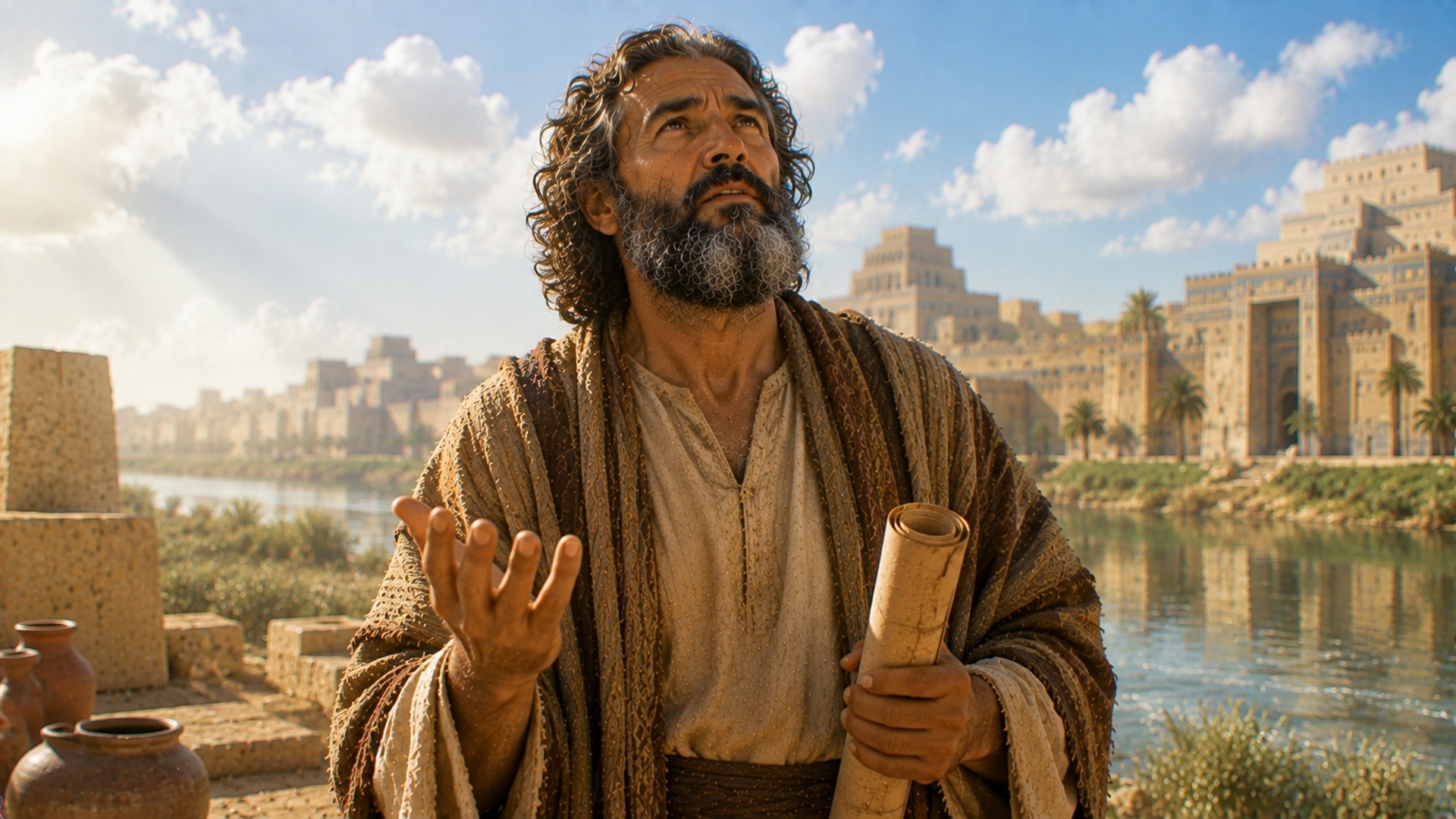
👤 The Biblical Person of the Day
👁️ Ezekiel – The Prophet of Visions and Hope
📌 Profile
- Name: Ezekiel
- Time of birth: approximately the 7th century BC
- Place of birth: probably Judah
- Time of death: unknown
- Age: unknown
- Occupation: Priest and prophet in exile
📖 Short Story
Ezekiel was a priest and prophet of God who was taken to Babylon together with many other Jews. There, far from Jerusalem and the temple, he received God’s Word and became an important messenger to the people in exile.
His calling began with a mighty vision of the glory of God. Ezekiel saw images filled with power, movement, and light, making one truth unmistakably clear: God’s glory was not confined to Jerusalem.
God appointed Ezekiel as a watchman for the house of Israel. He was to warn and admonish the people and faithfully deliver God’s message, even when many refused to listen.
His message was often serious. He had to show the people why Jerusalem would fall and why God’s judgment was coming upon sin, idolatry, and unfaithfulness.
But Ezekiel did not proclaim judgment alone. He also spoke of hope, restoration, and a new beginning that God would provide.
His promise of a new heart and a new spirit is especially well known. God did not merely want to bring his people back outwardly; he wanted to renew them inwardly.
Ezekiel’s story shows that God also speaks in foreign lands, offers hope even in judgment, and can create new life out of what appears to be dead.
🔥 The Decisive Moment
Ezekiel sees the glory of God in exile and is appointed as a watchman who must faithfully proclaim God’s Word.
✨ 7 Remarkable Facts About Ezekiel
- He was both a priest and a prophet
- He lived among the exiles in Babylon
- He saw a mighty vision of the glory of God
- He was appointed as a watchman for Israel
- He proclaimed judgment upon Jerusalem’s unfaithfulness
- He prophesied about a new heart and a new spirit
- He saw the vision of the valley of dry bones
⚖️ Strengths & Weaknesses
✔ obedient to God’s commission
✔ faithful in difficult surroundings
✔ courageous in proclaiming serious messages
✔ filled with hope in God’s restoration
❌ his message was often difficult to bear
❌ his personal life was deeply affected by his prophetic commission
❗ The Mistake That Shaped Him
The Bible does not record any particular personal failing of Ezekiel.
➡️ His life was primarily characterized by obedience, prophetic faithfulness, and a powerful hope in God’s renewing work.
📜 Key Verse
“I will give you a new heart and put a new spirit within you.” (Ezekiel 36:26)
🧠 The Life Lesson
God can renew a broken people, a hardened heart, and even a life that appears to be dead when he works through his Spirit.
🎯 Application for Today
Trust God even when you feel inwardly dry, distant, or broken. He can give new life where, from a human perspective, no hope remains visible.
❓ A Question for You
Where do you need God to give you a new heart, a new spirit, and new life today?
📌 Context
Ezekiel ministered among the exiles during the Babylonian captivity. His message explained the judgment upon Jerusalem while also directing the people’s attention toward God’s future restoration.
🔗 Connections
Ezekiel is connected with the Babylonian exile, Jerusalem, the glory of God, the commission of the watchman, the promise of a new heart, and the vision of the valley of dry bones.
Conclusion:
Ezekiel shows that God is present even in foreign lands. His message is serious, yet filled with hope: God judges sin, but he can renew hearts, gather his people, and create new life from dry bones.
See you tomorrow with the next biblical person! 📖
✨ The Life Story ✨
✨ The Life Story of Ezekiel – God’s Glory in a Foreign Land ✨
🌄 A Priest in Exile
Ezekiel was a priest, but his life unfolded very differently from what might have been expected of a priest. Instead of quietly carrying out his ministry in the temple in Jerusalem, he found himself among the exiles in Babylon.
The exile was a profound shock for the people of Judah. Many had lost their homeland, security, temple, and familiar way of life. A heavy question weighed upon their hearts: Was God still with his people?
It was precisely in this foreign land that God began speaking powerfully to Ezekiel. In this way, the Lord demonstrated that his presence is not confined to walls, cities, or human forms of security.
👁️ The Vision of God’s Glory
By the River Chebar, Ezekiel saw a mighty vision. He saw living creatures, wheels filled with movement, light, fire, and above everything something resembling a throne.
These images were difficult to express in human words. They did not reveal a small god who had been weakened by Judah’s defeat, but the Lord in all his glory, power, and majesty.
Ezekiel fell facedown. In the presence of God’s glory, human beings become small—but it is precisely there that a genuine calling begins.
📣 The Call to Be a Prophet
God spoke to Ezekiel and sent him to the house of Israel. He was to speak to a rebellious people who would not readily listen.
This calling was not comfortable. Ezekiel had to deliver words that were difficult, serious, and challenging.
But God also gave him strength. The Spirit lifted him up, set him on his feet, and enabled him to accept the commission.
🛡️ The Watchman for Israel
Ezekiel was appointed as a watchman. A watchman stands upon the wall, sees danger approaching, and warns the people.
This responsibility carried great weight. If Ezekiel failed to deliver God’s warning, he would bear guilt. If he gave the warning, he remained faithful even when the people refused to listen.
His story therefore demonstrates that God’s messengers are not primarily judged by their success, but by their faithfulness to the Word they have received.
🔥 Symbolic Actions and Difficult Messages
Ezekiel not only had to speak God’s message, but sometimes also had to illustrate it through symbolic actions. His own life became a prophetic sign.
He symbolically portrayed the siege of Jerusalem, the guilt of the people, and the coming judgment. His messages were urgent because the people’s situation was serious.
God wanted his people to understand that the exile had not occurred by accident. It was the result of prolonged unfaithfulness, idolatry, injustice, and the rejection of divine warnings.
🏙️ The Glory Departs from the Temple
One of Ezekiel’s most distressing visions shows the glory of God departing from the temple. This was a profound sign of judgment.
The temple was the place where God’s name was meant to dwell. But when the people rejected the Lord and defiled the temple, outward religion could not compel God’s presence to remain.
This vision was a solemn warning: God’s presence must never be treated as something that can be taken for granted.
👤 Individual Responsibility
Ezekiel also spoke clearly about personal responsibility. The people could not simply hide behind the sins of previous generations.
Through him, God made it clear that every person is accountable before the Lord. The righteous person is to live in righteousness, while the wicked person is called to turn back and live.
This message opened the door to hope. No one had to say, “My path is hopelessly and permanently lost.” God calls people to repentance so that they may live.
💗 The New Heart
In the midst of his serious messages of judgment, Ezekiel proclaimed one of the Bible’s most beautiful promises. God promised to give his people a new heart and a new spirit.
He would remove the heart of stone and give them a heart of flesh. The promise was therefore not merely about returning to a particular land, but about inward renewal.
This promise reveals God’s profound purpose: he does not merely want to bring outward order to people’s lives, but to transform them from within.
🦴 The Valley of Dry Bones
In a vision, Ezekiel saw a valley filled with dry bones. From a human perspective, there was no hope, no breath, and no life.
But God asked him: “Son of man, can these bones live?” Ezekiel answered humbly: “O Lord GOD, You know.”
Ezekiel then proclaimed God’s Word over the bones, and they came together. God gave them breath, and the valley of death became a picture of new life.
🌿 Hope for a Restored People
The vision of the dry bones showed Israel that God had not forgotten his people. Even though they appeared dead, scattered, and hopeless, God could gather them again and restore them to life.
Ezekiel proclaimed that God would bring his people back, cleanse them, and lead them under one Shepherd.
Thus, the prophet of judgment also became a prophet of great hope. God’s final word over his people was not death, but life.
✨ The Enduring Message of His Life
Ezekiel shows that God’s glory can become visible even in exile. No place is too distant, no situation too dark, and no people too broken for God to speak.
His story reminds us that God takes sin seriously, yet at the same time gives a new heart, a new spirit, and new life. The Lord can transform dry bones into a living people.
🌌 Closing Thought
Ezekiel was a priest without a temple ministry in Jerusalem, but God made him a powerful prophet in a foreign land.
He saw God’s glory, delivered God’s warnings, and proclaimed God’s hope to a broken people.
👉 His life story shows us that even in exile, judgment, and apparent hopelessness, God can reveal his glory and create new life through his Spirit.
