


🌅 Back to the Source of Life
Sabbath reflections for silence, renewal, and encountering God
🙏 The Prayer That Changes the Heart
🛤️ 4. Your Will Be Done
“Your will be done on earth as it is in heaven.”
Matthew 6:10 – second part
🕊️ A Story – in the Garden of Decision
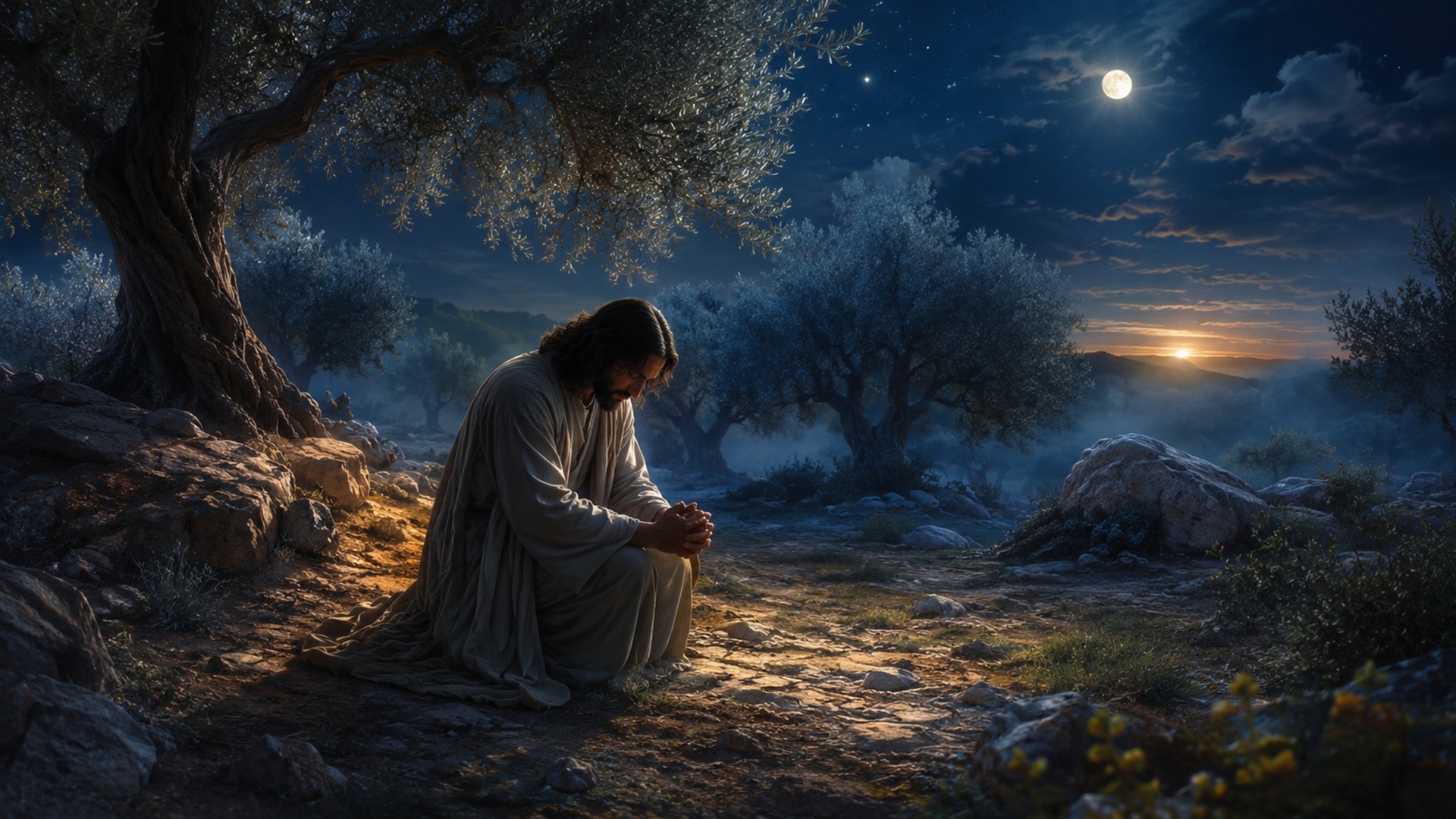
The night was quiet, yet in that garden there was a heaviness that was almost unbearable. Among the trees of Gethsemane, Jesus was alone. The hours before had already brought Him to a point where everything was clear — and yet inwardly difficult.
He knew what lay ahead of Him.
It was not an unknown path, not a sudden event. It was a decision that could no longer be avoided. And precisely in this moment we see something that is often overlooked: the inner struggle.
Jesus prayed.
Not superficially, not calmly, but with a depth that reached into pain. The words He spoke show us something of this tension:
“Father, if it is possible, let this cup pass from Me; nevertheless, not as I will, but as You will.”
(Matthew 26:39)
In this prayer, two realities meet: the human desire to avoid suffering and the conscious decision to entrust oneself to the will of God.
Jesus does not suppress this inner conflict. He speaks it out. And precisely in this lies the depth of this moment.
In the end there is no forced surrender, but a voluntary yielding.
🌿 What Does “Your Will Be Done” Mean?
These words are among the most difficult in the entire prayer. They are easy to say, but deep in their meaning.
“Your will be done” does not first mean that we understand everything. Nor does it mean that we always know what is right. Rather, it means that we become willing to trust God — even where we cannot see everything.
It is an attitude in which we no longer ask only, “What do I want?” but begin to ask, “What does God want?”
Ellen G. White describes this attitude in this way:
“When we pray, ‘Your will be done,’ we place our own will in God’s hands. We trust that His ways are better than ours and that He guides us, even when we do not fully understand the path.”
(Ellen G. White, Thoughts from the Mount of Blessing, chapter “The Lord’s Prayer”)
And she further writes:
“True faith is shown when a person is willing to accept God’s will, even when it is connected with difficulties. This surrender brings peace because it places life in God’s hand.”
(Thoughts from the Mount of Blessing, chapter “The Lord’s Prayer”)
🔥 The Inner Resistance
It is honest to say: these words do not come easily to us.
We have our own ideas, our own wishes, our own plans. We want to understand, control, and secure things. And precisely here the tension arises.
“Your will be done” means giving up control. It means acknowledging that God sees more than we do. And it means trusting Him, even when we ourselves are uncertain.
This step is not a one-time moment, but a path. Again and again, we stand before situations in which we must decide anew whom we will trust.
🌙 Surrender That Brings Peace
Interestingly, this surrender does not lead to uncertainty, but to peace. Not because all questions are answered immediately, but because the burden of our own control falls away.
Ellen G. White describes it this way:
“Whoever places his life in God’s hands will experience being upheld. Even when the path leads through trials, the certainty remains that God guides and accompanies.”
(Thoughts from the Mount of Blessing, chapter “The Lord’s Prayer”)
Surrender, therefore, is not a loss, but a gain — even if at first it feels like letting go.
🌾 The Sabbath as a Place of Surrender
The Sabbath is more than a day of rest — it is a day of trust. Every Sabbath hour reminds us that we do not have to carry everything ourselves. During the week, we are often under pressure to make decisions, solve problems, and take responsibility. Much seems to depend on our actions.
But with the Sabbath, God gives a special invitation: “Let go. Trust Me.”
That is exactly why the Sabbath is deeply connected with the petition: “Your will be done.” For true surrender begins where we acknowledge that God is God and we are not. The Sabbath deliberately interrupts our striving, our planning, and our constant effort to want to control everything. It reminds us that, ultimately, our life lies in God’s hands.
When Israel lived in the wilderness, the people learned this lesson through the manna. On the Sabbath they were not to gather, not to provide in advance, and not to take care of their provision themselves. They had to trust that God had already provided for them. In this way, every Sabbath became an exercise of faith.
Today, too, the Sabbath asks us the same question: Do you trust that God is at work even when you pause? Do you believe that His guidance continues even when you take a step back?
Ellen G. White writes:
“The Sabbath is a sign of humanity’s complete dependence on God. It reminds us that we are creatures and that our life is sustained by His power and care.”
Especially in a time when many people want to plan, secure, and control everything, the Sabbath becomes a special expression of surrender. It teaches us that peace does not come from having everything under control, but from entrusting ourselves to the One who holds everything in His hand.
Therefore, the Sabbath invites us to consciously lay our worries before God. The unresolved questions, the open decisions, the fears about the future, and the burdens of everyday life may rest for a moment. Not because they have disappeared, but because we hand them over to the One whose will is good, wise, and perfect.
In this way, the Sabbath becomes a place where each week we can learn anew what Jesus lived out in Gethsemane. We too may come before the Father with everything that moves us. We may express our wishes, ask our questions, and honestly name our struggles. But in the end, we may say like Christ:
“Not my will, but Your will be done.”
In this attitude lies a freedom that the world cannot give. For whoever entrusts themselves to God’s will no longer has to carry everything alone. They may rest — not only physically, but also in the heart.
Thus the Sabbath becomes a holy space of surrender, where week by week we learn anew to trust God’s guidance and to find peace in His will.
🤲 Invitation
Today, consciously speak these words: “Your will be done.” Not quickly, not as a habit, but as a decision.
Perhaps there is an area in your life that you are holding tightly. A point where it is difficult for you to let go.
Bring exactly that before God.
✨ Prayer
Father,
You know my wishes and my plans.
You see how often I hold on,
how much I want to understand and control.
I ask You:
teach me to trust.
Help me to accept Your will,
even when I do not fully understand it.
Take the unrest from my heart
and give me peace in Your guidance.
And lead me step by step
on Your path.
Amen.


