


🤩 Bible Stories to Marvel At
Where God’s miracles become great – for little and big children
🌒 Job Chapter 24 – Job Asks About Injustice in the World
⚖️ When Injustice Remains Visible for a Long Time
🌅 Introduction
In the previous chapter, Job had spoken about his deep longing for God. He wanted to find God, stand before Him, and present his case. He had looked ahead, behind him, to the left, and to the right, but God remained hidden from him.
Yet in the midst of this darkness, Job held on to an important truth: God knows my way. Job could not see God, but he believed that God saw him. He could not hear God’s answer, but he believed that God knew his story.
Now Job turns his attention to the world around him. He does not see only his own suffering. He also sees the suffering of other people. He sees the poor being exploited. He sees the weak, whom no one protects. He sees people doing evil in the darkness and still not being stopped immediately.
This makes Job’s questions even greater. If God is just, why are there times when injustice remains visible for so long? Why does it sometimes seem as though evil people can continue with their lives while the poor and vulnerable are forced to wait?
This chapter tells how Job reflects on God’s justice. He asks difficult questions, not because justice does not matter to him. On the contrary, he asks because he knows that God is just. That is precisely why he cannot understand why God’s intervention sometimes remains hidden.
📖 The Biblical Story
🕰️ Job Asks About God’s Timing
Job begins with a difficult question. Why are the times of judgment not openly visible? Why do people who know God not always see immediately when He intervenes and establishes justice?
Job longs for God to bring injustice to a clear end. He wants to see the truth come to light, the weak protected, and those who do evil prevented from continuing undisturbed.
This question comes from a heart that suffers because of injustice. Job does not see only himself. He sees an entire world full of wounds. And he asks: God, You are just. Why does Your judgment so often remain hidden?
For children, we can imagine it like this: if a stronger child takes something away from a weaker child in the schoolyard, we hope that a teacher will see it and help immediately. But when no one intervenes, it feels wrong and sad. Job feels something similar when he looks at the wider world.
🪨 People Move Boundaries and Take from Others
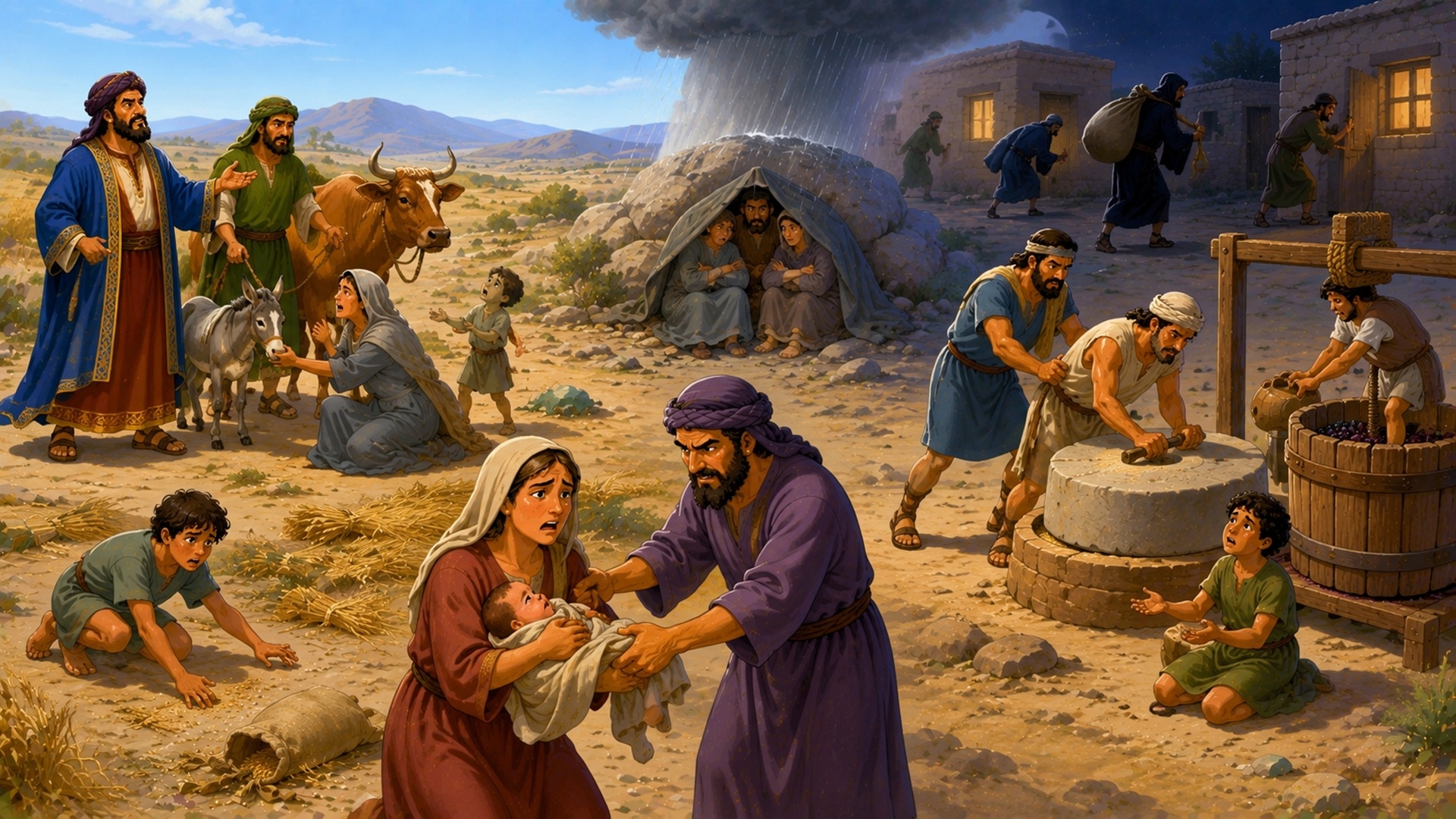
Job then describes people who commit injustice. They move boundary stones so that they can claim more land. In those days, a boundary stone showed where one person’s field began and ended. Anyone who moved it secretly took something that did not belong to them.
Job also speaks of people who steal herds and lead other people’s animals onto their own pastures. They behave as though everything belongs to them. They take what others need in order to live.
This is not merely a small disagreement about possessions. For poor people, a piece of land or an animal could determine whether they were able to eat, work, and survive. Whoever took these things from them also took away their security and future.
Job sees such actions and wonders why God does not stop these people immediately. The wrongdoers act boldly, and the victims suffer. This makes his question about God’s justice especially serious.
🐴 The Weak Lose What They Need
Job continues by describing how even an orphan’s donkey is taken away. In those days, a donkey was an important animal. It could carry loads, help work the fields, and make daily life easier. For a poor child without a father, such an animal was extremely valuable.
He also speaks of a widow’s ox being taken as security for a debt. A widow often had little protection in society. If the animal that helped her work was taken away, her life became even harder.
These images show how cruel people can become when they have no compassion. They do not take only from the rich, who have plenty left over. They take from the weak the very things they desperately need.
Job brings these scenes before our eyes so that no one can say too quickly, “Everything is simple.” No, the world is sometimes full of injustice, and the weak are usually the first to feel it.
🏜️ Poor People Are Pushed Aside
Job says that the poor are forced off the road. They hide because powerful people leave no room for them. They are pushed to the margins, as though they have no place in the world.
We can imagine it like a road on which only the strong can walk safely. The weak must step aside, hide, and hope that they will not lose even more.
Job sees poor people searching for food in the wilderness. They gather whatever they can find so that their children will not go hungry. Their lives are hard, exhausting, and full of uncertainty.
God does care about these people. But Job asks: why does it sometimes seem as though they must wait so long before receiving help? Why are the hard-hearted allowed to keep their power for so long?
🌾 They Work in the Fields but Remain Hungry
Job describes people who work in other people’s fields and yet remain poor themselves. They harvest, but the abundance does not belong to them. They carry grapes and gather crops, but they do not have enough for their own lives.
This is especially sad. Someone may work all day, sweat, and become exhausted, yet still go hungry. Others enjoy the profit while the worker barely has enough.
For children, we might say: imagine helping all day to prepare a table full of bread, but in the end, you are not allowed to eat any of it. That feels unfair. This is how Job describes the lives of some poor people.
Job sees not only theft and violence. He also sees unfair work, in which people are used without being given enough. To him, this too is part of the injustice of the world.
🌧️ People Shiver Without Protection
Job then speaks about people who lie outside at night without proper clothing. They have no blanket to protect them from the cold. Rain falls on them, and they seek shelter among rocks because they have no home to keep them warm.
These words are very sad. They show people who are not only poor but also completely unprotected. While others sleep inside houses, they lie outdoors and shiver.
Job sees their suffering. He does not look away. He describes it in such a way that even his friends cannot ignore it. If they constantly talk about guilt and punishment, they must also see the tears of the poor.
Job reminds us that justice is not merely an idea in the mind. Justice concerns real people, hunger, cold, fear, and the absence of protection.
👶 Families Are Torn Apart
Job also speaks about children being torn away from their mothers and about possessions being taken from the poor as security for debts. These are especially painful images. They show how cruel people can become when they think only about power, money, and personal advantage.
A child belongs close to its mother. There, the child finds warmth, protection, and love. When a child is taken away, it is a great injustice and a source of deep pain.
Job wants to show that evil is not merely an idea. It strikes families. It brings tears into homes. It causes sorrow to children and parents. It destroys trust and security.
That is why Job asks so seriously: if God is just, why are such things allowed to happen? Why is it not immediately visible that God protects the weak?
🍇 They Press Oil and Wine, Yet Remain Thirsty
Job describes another sad scene: people press oil between walls and tread grapes in winepresses, yet they themselves suffer from thirst. They work with things that bring joy and wealth to others, but they do not receive enough for themselves.
The image is powerful. Oil and wine were valuable. They represented provision, celebration, and life. Yet the workers who produced these things remained in need.
It is as though their hands bring abundance to others while their own hands remain empty. Job sees this as a deep injustice.
This description makes Job’s chapter very vivid. We can almost hear the tired steps of the workers, see their dusty hands, and feel their dry throats. Job wants his friends to see this reality.
🏙️ Groaning Rises from the City
Job does not look only at fields and deserts. He also hears groaning rising from the city. Wounded people cry out, and the souls of the injured call for help.
This means that injustice can be found everywhere: in the countryside, where the poor work in fields; in the wilderness, where people search for food; and in the city, where violence and pain become visible.
Job hears these cries. He takes them seriously. He realizes that the world is not as orderly as his friends claim. There are wounds that are not bandaged immediately. There are cries that seem to remain unanswered for a long time.
Then Job says something difficult: God does not immediately call them to account for their wrongdoing. By this, he means that God’s intervention is not always immediately visible. That is exactly what troubles him.
🌑 Some People Love the Darkness
Job now describes people who rebel against the light. They do not want to know God’s ways and do not remain on His paths. Light reveals what is true. But those who want to do evil avoid the light.
He speaks of people who act in darkness. The murderer rises early to harm the poor and needy. The thief waits for the night. The adulterer hides his face and thinks that no one sees him.
For children, we can say: when someone does something good, they do not need to hide. But someone who secretly plans evil often looks for darkness. They do not want to be seen.
Job shows that evil people often know very well that their actions should not come into the light. They love the darkness because they do not want anyone to discover their guilt.
🚪 The Night Becomes Their False Friend
Job describes how the night becomes a familiar place for such people. While others use the night for sleep, they use it for secret actions. They break in, hurt others, deceive, and hide.
But this hiding does not provide real safety. It is only an attempt to avoid the truth. People may be able to hide from other human beings, but they cannot hide from God.
Job knows this. Yet he still asks why God does not immediately bring such people out of the darkness. Why are they sometimes allowed to behave for so long as though no one sees their deeds?
This is a difficult question. But it shows how seriously Job takes God’s justice. He does not want evil to remain hidden. He longs for God’s light to become more clearly visible.
🌊 Job Knows That Evil Will Not Last Forever
Even though Job asks why God does not intervene immediately, he knows that evil has no secure future. He describes evil people as something quickly carried away on the water. In the end, their fields and vineyards bring no lasting blessing.
He compares their end to snow disappearing in the heat. Snow may cover a landscape, but when the sun grows stronger, it melts. In the same way, false security can disappear.
Job knows that God does not forget injustice. Even when judgment is not immediately visible, evil will not remain strong forever. Darkness cannot resist God’s light forever.
Yet Job’s question remains: why does it sometimes take so long? Why must the poor suffer for so long before justice becomes visible?
🌿 The Powerful Seem Safe for a Time
Job sees that some violent people seem strong for a while. They remain standing while others fall. They are given more time even though their ways are evil.
This can be very confusing. When someone does wrong and still succeeds, people ask: does God see it? Will He do something? Why does He wait?
Job speaks these questions openly. He does not want easy answers. He looks at the world with honest eyes. Some things cannot be understood immediately.
But even though the powerful may seem safe for a time, they are never truly outside God’s sight. Their security is only borrowed. No one can escape God’s justice forever.
🍂 In the End, They Are Cut Down Like Heads of Grain
Finally, Job describes how such people are raised up for a time but then pass away. They are gathered like everyone else and cut down like the tops of grain.
The picture of grain is easy to understand. A stalk grows in the field. For a time, it stands tall in the wind. But when the harvest comes, it is cut down. Its season does not last forever.
In this way, Job says that although evil people may appear strong for a while, they will not remain forever. God sees. God knows. In the end, God will judge rightly.
Yet Job remains honest: the path until then is difficult. For those who suffer, the waiting feels long. For the poor, every day without justice is a painful day.
🌟 Job Confronts His Friends with the Truth
At the end, Job challenges his friends. If his observations are not true, they should prove him wrong. He is willing to face the truth. But he does not want his friends to make reality seem smaller than it is.
Job shows them that the world is full of injustice and that God’s judgment is not always immediately visible. Therefore, people should not quickly claim that they can explain every kind of suffering.
This chapter is difficult, but important. It helps children and adults understand that the Bible does not hide real questions. Job is allowed to ask why the poor suffer and why evil people sometimes continue living. God allows these questions to remain in His Word.
And although Job has not yet received an easy answer, we know this: God sees injustice. No cry is forgotten by Him. No person is invisible to God.
🌅 What This Chapter Shows
This chapter shows that Job does not think only about his own suffering. He also sees the injustice in the world: the poor are exploited, widows and orphans are oppressed, workers remain hungry, and people do evil in the darkness.
This chapter also shows that God’s justice sometimes seems hidden. Job asks why God does not immediately intervene in a visible way. Yet at the same time, he knows that evil has no eternal future and that God does not forget injustice.
🟣 Summary
In chapter 24, Job asks why God’s appointed times of judgment are not openly visible. He describes people who move boundary stones, steal herds, drive the poor away, exploit widows and orphans, and leave workers hungry. He sees people shivering without protection, children being taken away, and others doing evil in the darkness. Job asks why God does not stop these actions immediately. At the same time, he recognizes that evil will not last forever. Although the powerful may appear safe for a time, they will eventually pass away. Job shows his friends that the world is far more complicated than their simple explanations suggest.
💚 Message for Children Today
God sees people who are poor, weak, or sad. Even when help does not seem to come immediately, their tears are not forgotten by God. Therefore, we too should not overlook people in need.
Job also shows us that we are allowed to ask difficult questions when we see injustice. But we should not stop believing in God’s justice. God sees more deeply and forgets no suffering.
💭 Questions for Reflection
🔸 Which people suffer most from injustice in Job’s description?
🔸 Why does Job ask about God’s times of judgment?
🔸 How can we help people today who are weak or disadvantaged?
🧒 👧 👦
💌 Invitation to Job Chapter 25
🌌 Bildad Speaks Briefly About God’s Greatness
Job has looked at the injustice in the world. He has asked why poor and weak people sometimes have to suffer for so long and why God’s judgment is not always immediately visible.
Now Bildad will answer once more. This time, his speech is brief. He speaks about God’s rule, God’s purity, and how small human beings are before Him.
Will Bildad answer Job’s difficult questions?
Come along and discover the next chapter!
🔔 Preview of Job Chapter 25
✨ When God’s Greatness Outshines Everything
Bildad looks upward and speaks about God’s power and purity. Before God, even the moon and the stars do not appear perfectly bright.
👉 Why does Bildad speak about God’s rule?
👉 What does he say about human beings before God?
👉 And why does his short speech still fail to provide a real answer to Job’s questions?
✨ In the next chapter, we will hear Bildad’s final brief speech and discover that even true words about God’s greatness do not explain every pain.
