


🌍 WHEN THE WORLD IS APPROACHING ITS END
🕯️ Hope, Watchfulness, and Faithfulness in Matthew 24–25
📖 Part 1 – Sermon 2
⏳ When the Days Are Shortened – Preserved Through the Great Tribulation
🛡️ God Sets a Limit to Tribulation and Preserves His People
📜 Main Text
“For then there will be great tribulation, such as has not been since the beginning of the world until this time, no, nor ever shall be. And unless those days were shortened, no flesh would be saved; but for the elect’s sake those days will be shortened.”
Matthew 24:21–22
🛡️ Key Verse
“God is faithful, who will not allow you to be tempted beyond what you are able, but with the temptation will also make the way of escape, that you may be able to bear it.”
1 Corinthians 10:13
🔦 Sermon Theme
God has never promised His people that they will avoid every tribulation. He has promised, however, to limit the power of evil, never to abandon His children during their trials, and to preserve them through a living relationship of faith with Christ. The shortening of the days therefore does not reveal weakness on God’s part, but His merciful and sovereign rule over a crisis that, without His intervention, would destroy all life.
🌅 Welcome and Introduction
Dear church family, when we read the words of Jesus about the great tribulation, images of persecution, war, famine, disasters, and a disintegrating world may easily arise in our minds. Some people respond to such passages with fear, others attempt to pass over them as quickly as possible, and still others become so absorbed in the details of the coming crisis that Christ Himself disappears from the center of their attention. Jesus, however, did not give us Matthew 24 to fill our imaginations with terrifying pictures or lead us into speculative calculations. He wanted to prepare His disciples to continue trusting Him even when, from a human perspective, everything appears to be slipping out of control.
The decisive words within our main text are therefore not merely, “Then there will be great tribulation.” Jesus immediately adds, “For the elect’s sake those days will be shortened.” The warning itself already contains a promise. The tribulation is real, but it is not unlimited. The power of evil is terrifying, but it is not sovereign. Satan can oppress, deceive, persecute, and destroy, but he cannot cross the boundaries God establishes for him. Above the whole of history, including its darkest hours, stands the hand of the One who knows the beginning and the end and who will not leave His people within the trial for a single hour longer than His eternal plan of redemption permits.
We must understand this truth before discussing the details of the great tribulation. If we look only at the crisis, we will become afraid. If we look to Christ, however, we will recognize that the crisis is bounded on every side by His presence and sovereign rule. Jesus does not say that His followers will never suffer. He says that their suffering will not be meaningless, endless, or beyond the reach of His preserving hand.
🕯️ Narrative Illustration: The Night Before the Escape
The following story is a narrative reconstruction set against the background of the events preceding the destruction of Jerusalem.
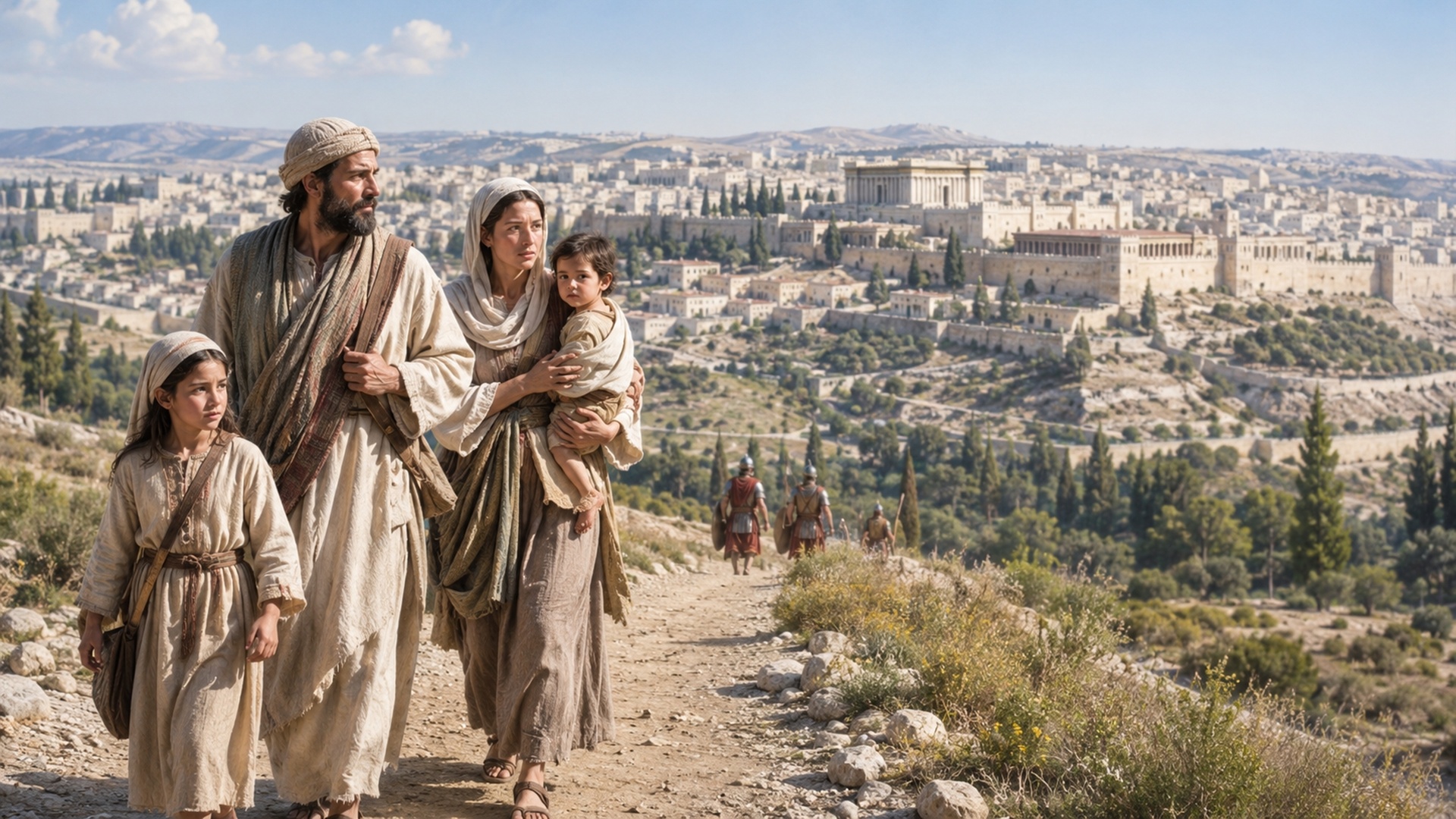
The sun had already disappeared behind the hills, yet an unusually large number of lamps still burned within Jerusalem. Shouts could be heard from the walls through the narrow streets, and men repeatedly hurried past the houses carrying weapons, water jars, or sacks of grain. Life had changed since the Roman troops appeared outside the city. No one knew what the following day would bring. Rumors spread more quickly than reliable news, and every new voice in the streets seemed to predict a different future.
In the upper room of a small house, a family sat around a low table. Matthias, the father, had carefully locked the door and turned the lamp down until its light was hardly visible from outside. His wife, Hannah, held their youngest son in her arms while their twelve-year-old daughter, Miriam, knelt beside a traveling bundle. It contained several garments, a water bag, dried figs, and a few small loaves of bread.
“Are we really leaving tonight?” Miriam asked quietly.
Matthias did not answer immediately. For several days, he had been speaking with other followers of Jesus about the Lord’s warning. Many years had passed since Jesus told His disciples on the Mount of Olives that Jerusalem would be surrounded by armies. Christ had instructed them to flee as soon as they recognized the promised sign. The Roman army had now actually arrived, but then something no one expected had happened: the troops suddenly withdrew.
Many people in the city were already celebrating this retreat as a victory. Armed groups had pursued the Romans, and voices in the streets proclaimed that God had miraculously delivered Jerusalem. Some men laughed at the Christians who wanted to abandon their homes. They claimed that anyone who fled now merely proved that they possessed neither courage nor trust in God.
“Perhaps the others are right,” Hannah said with a trembling voice. “The Romans have gone. Perhaps the danger truly is over.”
Matthias looked at the small bundle beside his daughter. The house had belonged to his father, and he himself had been born there. His tools stood in the workshop behind the courtyard. The beams he had replaced only the previous year lay across the roof. The family’s savings were hidden in a small vessel beneath the floor. If they left now, they did not know whether they would ever return.
“I have had the same thought,” he admitted. “My eyes see an army withdrawing, but within my heart, I hear the words of Jesus.”
He took the small scroll lying on the table and reminded his family of the message handed down by the first disciples:
“But when you see Jerusalem surrounded by armies, then know that its desolation is near. Then let those who are in Judea flee to the mountains.”
Luke 21:20–21
Miriam looked attentively at her father. “But why must we flee when the soldiers have already gone?”
“Because Jesus did not say that we should wait until we understood everything,” Matthias answered. “He gave us a sign and told us what to do when that sign appeared. We must decide whether we trust His Word more than what appears safe at this moment.”
Just then, three quiet knocks sounded at the door. Matthias was startled, extinguished the lamp, and waited. Then he heard the familiar voice of his friend Simeon.
“We are leaving,” Simeon whispered after entering. “The road to the north is still open. Several families are already waiting outside the city.”
Hannah held the child more tightly. “How long will the journey take?”
Simeon shook his head. “No one knows.”
“And where will we live?”
“We do not know that yet either.”
“Will we have enough to eat?”
Once again, Simeon could offer no certain answer. He looked at Matthias and said, “We do not know what the entire journey will look like. We know only that the Lord has told us when we must depart.”
The family left the house shortly before midnight, taking only what they could carry. Matthias locked the door even though he knew that a lock could not stop the events to come. Miriam paused once more and looked up at the small window of her room.
“When will we return?” she asked.
Her father placed his hand on her shoulder. “Perhaps we will not return, but Jesus will go with us.”
They moved quietly through the streets and joined a group of believing families outside the city. Elderly people were supported, children were carried, and their limited provisions were shared among them. No one knew whether soldiers, robbers, or blocked roads awaited them beyond the next hill. Nevertheless, they continued because they remembered the words of Christ.
After several hours, the youngest son began to cry. Hannah was exhausted, Miriam’s feet hurt, and even Matthias began to wonder whether he had led his family into a danger they might have avoided. Behind them, Jerusalem was still visible. The city lay peacefully in the early morning light, and nothing suggested that its final days had already begun.
They paused briefly at the edge of an olive grove. Miriam sat on a stone and asked, “Father, how long will this difficult time last?”
Matthias looked at the weary faces of those who had abandoned everything because they believed the words of Jesus. He did not know the answer. He could not give his daughter a date or promise her an easy road. He remembered, however, a sentence the disciples had preserved from the discourse of Jesus.
“The Lord said that the days of tribulation would be limited,” he answered. “We do not know how long they will seem to us, but we know they cannot last longer than God permits.”
“How do you know?”
“Because Jesus did not merely warn us. He also showed us that He had already looked into the future before us. Before we saw the danger, He already knew it. Before we knew we would need to flee, He had prepared a way. Before the tribulation begins, He already knows the hour in which it will end.”
Miriam looked back at the city. Its walls still appeared strong and secure in the morning light, while the road before her was unknown. Nevertheless, she stood, picked up her small bundle, and continued with the others.
Many years later, she would understand how merciful that brief opportunity had been. The Romans returned, Jerusalem was surrounded again, and the city experienced suffering whose horror can hardly be expressed in words. The army’s unexpected withdrawal, however, had opened a window of time during which the followers of Jesus could escape. The danger had not disappeared, but God had limited its power and prepared a way for His people.
Miriam never forgot what her father had told her that morning: before the tribulation begins, God already knows the hour in which it will end.
1. 📖 Jesus Does Not Conceal the Coming Tribulation
The story brings us to the words Jesus spoke on the Mount of Olives. His disciples had asked Him about the destruction of the temple, the sign of His return, and the end of the age. Jesus did not soften the future in His response. He spoke of false christs, wars, famines, earthquakes, persecution, and religious deception. His purpose, however, was not to paralyze His disciples, but to prepare them.
Jesus said:
“Then they will deliver you up to tribulation and kill you, and you will be hated by all nations for My name’s sake. And then many will be offended, will betray one another, and will hate one another. Then many false prophets will rise up and deceive many. And because lawlessness will abound, the love of many will grow cold.”
Matthew 24:9–12
These words show that the crisis will not consist only of outward pressure. External persecution will be joined by internal deception, betrayal, hatred, and the cooling of love. This is one of the greatest dangers of the tribulation. People may endure severe outward circumstances and still perish spiritually if their trust collapses, their love grows cold, or they turn away from the truth.
Jesus therefore adds:
“But he who endures to the end shall be saved.”
Matthew 24:13
Endurance here does not mean saving ourselves through human willpower. It means remaining with Christ as the pressure increases. Faith does not endure because human beings are naturally strong, but because they cling to a mighty Savior. Jesus therefore directs our attention not primarily to the severity of the tribulation, but to the necessity of a relationship with Him that will remain steadfast under pressure.
Those who concern themselves only with events may remain unprepared despite all their prophetic knowledge. Those who know Christ, trust His Word, and live daily by His grace possess the only preparation that will truly sustain them during the final crisis. Prophetic knowledge should not merely inform us, but draw us closer to Jesus.
2. ⏳ What Does It Mean That the Days Will Be Shortened?
Jesus says that no one would be saved if those days were not shortened. In these words, He describes the destructive nature of evil. Sin contains no natural limit within itself. When it is not restrained, it spreads, hardens hearts, destroys relationships, abuses power, and eventually threatens life itself. The history of Jerusalem reveals with terrible clarity where people can arrive when hatred, fanaticism, power struggles, and delusion take control.
Jesus declares, however, that God will intervene. The shortening of the days first means that He establishes a temporal limit for the tribulation. Evil is not permitted to act endlessly. It does not possess unrestricted access to history, but operates within the boundaries of divine permission. We already encounter this truth in the Book of Job. Satan wanted to destroy Job completely, but God said:
“Behold, all that he has is in your power; only do not lay a hand on his person.”
Job 1:12
Satan was later granted additional scope to act, but God again established a clear limit:
“Behold, he is in your hand, but spare his life.”
Job 2:6
Job did not know what had happened in heaven. He saw only the loss of his possessions, children, and health. What he could not see was the boundary God had placed before the enemy. Satan was permitted to afflict him, but he was not allowed to do everything. Even when Job felt abandoned, his life remained surrounded by God’s invisible sovereignty.
The same truth applies to the great tribulation. Events may appear to indicate that evil has assumed complete control. Nevertheless, God remains Lord over the beginning, extent, and end of the crisis. Jesus does not say, “Perhaps the days will be shortened.” He says, “They will be shortened.” The boundary does not depend upon the mercy of human rulers, but upon the decision of God.
Paul applies this principle to our personal lives:
“No temptation has overtaken you except such as is common to man; but God is faithful, who will not allow you to be tempted beyond what you are able, but with the temptation will also make the way of escape, that you may be able to bear it.”
1 Corinthians 10:13
This passage does not promise that God will immediately remove every trial. Sometimes He creates a way out of the trial, and sometimes He provides a way through it. His faithfulness, however, always remains greater than the power of whatever afflicts us.
3. 🏛️ Jerusalem: The First Fulfillment of the Warning
The words of Jesus initially referred to the destruction of Jerusalem. He warned His disciples about a coming siege and gave them a recognizable sign:
“But when you see Jerusalem surrounded by armies, then know that its desolation is near. Then let those who are in Judea flee to the mountains.”
Luke 21:20–21
In AD 66, Roman troops under Cestius Gallus surrounded the city. Although a further advance appeared possible, they unexpectedly withdrew. This created a limited opportunity to escape. The Christians remembered the words of Jesus and left Jerusalem before the final siege began. When the Romans later returned, the city was surrounded, and its destruction followed in AD 70.
The decisive factor was not that the believers understood every military development. They were preserved because they listened to Christ’s warning and acted upon it. God opened a window of opportunity, but they had to use it in faith. If they had waited until every detail became clear, it would have been too late.
This contains an important lesson for us. God’s preservation does not remove our responsibility. When Christ speaks, we should not wait endlessly for His Word to be confirmed by visible circumstances. Faith means obeying the Lord even when the entire road is not yet visible before us.
Noah built the ark before rain fell. Abraham left his homeland without seeing the destination of his journey. Moses led Israel to the Red Sea before the waters parted. The Christians left Jerusalem when many others interpreted the Roman retreat as evidence of safety. In every one of these situations, faith meant esteeming God’s Word more highly than the immediate outward appearance.
4. 🔥 The Church’s Long Tribulation
The prophecy of Jesus extended beyond Jerusalem. The history of the Christian church includes long periods of severe persecution. The first Christians were imprisoned, tortured, and killed under Roman emperors. Later, religious-political systems arose that persecuted people because they sought to remain faithful to their consciences and the Word of God.
Daniel had foreseen a power that would oppress God’s people and attack His commandments:
“He shall speak pompous words against the Most High, shall persecute the saints of the Most High, and shall intend to change times and law.”
Daniel 7:25
Revelation 12 portrays the church as a woman who must flee from the dragon:
“Then the woman fled into the wilderness, where she has a place prepared by God, that they should feed her there one thousand two hundred and sixty days.”
Revelation 12:6
According to the prophetic day-year principle, these 1,260 days correspond to a historical period of 1,260 years. This period began with the consolidation of the medieval papacy’s religious-political supremacy and continued until 1798, when that power suffered a severe political blow. Nevertheless, the statement of Jesus about the shortening of the days means that intense persecution did not continue throughout the entire period with the same severity.
Ellen White summarizes this relationship:
“In mercy to His people, God cut short the time of their fiery trial.”
She then explains that the influence of the Reformation helped restrain persecution before the end of the 1,260 years. Ellen G. White, The Great Controversy, Chapter 15: “The Bible and the French Revolution”
The Reformation was therefore more than a theological controversy. Through the rediscovery of the Bible, the proclamation of justification by faith, and the struggle for freedom of conscience, God placed limits upon religious oppression. Persecution did not disappear everywhere or immediately, but its unrestricted power was broken. God shortened the fiery trial by causing light to arise, awakening people, directing political developments, and creating places where His Word could once again be proclaimed publicly.
This historical connection shows that God can shorten the days in different ways. He can open a way of escape, as He did at Jerusalem. He can awaken a movement of renewal, as He did during the Reformation. He can restrict systems of power, alter political conditions, or enable people to resist oppression. The instruments differ, but His sovereignty remains the same.
5. ⚔️ The Final Crisis and God’s Continuing Boundary
The prophecy of Jesus also points toward the final crisis before His return. Revelation describes a time in which religious deception, political power, and economic pressure will be united. People will be confronted with the decision of whether to follow human decrees or remain faithful to God’s commandments.
“He causes all, both small and great, rich and poor, free and slave, to receive a mark on their right hand or on their foreheads, and that no one may buy or sell except one who has the mark.”
Revelation 13:16–17
The final crisis will therefore be more than an economic, political, or social upheaval. At its center stands the question of worship. To whom does our highest loyalty belong? Which authority governs our conscience? Will we obey God’s commandments when obedience brings disadvantages?
As Seventh-day Adventists, we recognize in the Sabbath of the fourth commandment a special sign of God’s authority as Creator. The Sabbath reminds us that we did not create ourselves, cannot redeem ourselves, and cannot preserve ourselves through our own strength. Every week, it calls us to rest in God’s completed work and trust Him as Creator and Redeemer.
“Remember the Sabbath day, to keep it holy. Six days you shall labor and do all your work, but the seventh day is the Sabbath of the LORD your God.”
Exodus 20:8–10
Faithfulness to God’s law during the final crisis will not be preserved through knowledge alone. Those who know the Sabbath today merely as a correct doctrine but have not learned to entrust their entire lives to Christ will not stand through prophetic information alone. The final decision will reveal to whom our hearts already belong.
God’s shortening of the days also means that the final crisis will not continue endlessly. Revelation 17 describes powers that will act only for a limited period:
“And the ten horns which you saw are ten kings who have received no kingdom as yet, but they receive authority for one hour as kings with the beast.”
Revelation 17:12
The “one hour” points to the brevity of their final exercise of power. Evil will reach a terrifying climax, but that very climax stands immediately before its end. The powers of this world may create the impression that they have achieved final victory. In reality, their dominion is approaching the judgment of God.
6. 🛡️ Preservation Does Not Always Mean Being Spared
We must understand carefully what the Bible means by preservation. God does not always preserve His children from physical suffering. Many faithful people have been persecuted, imprisoned, or killed. Hebrews 11 first speaks about people who, through faith, subdued kingdoms, shut the mouths of lions, and escaped the edge of the sword. It then describes other believers who were equally faithful but experienced no visible deliverance:
“Others were tortured, not accepting deliverance, that they might obtain a better resurrection. Still others had trial of mockings and scourgings, yes, and of chains and imprisonment. They were stoned, they were sawn in two, were tempted, were slain with the sword.”
Hebrews 11:35–37
Both groups lived by the same faith. Some were rescued from danger, while others remained faithful to God unto death. Preservation in its deepest sense therefore means that no power can separate us from Christ.
Jesus told His disciples:
“And you will be hated by all for My name’s sake. But not a hair of your head shall be lost. By your patience possess your souls.”
Luke 21:17–19
At first glance, this passage appears contradictory. Jesus had just announced that some of His followers would be killed, yet He declared that not a hair of their heads would be lost. He was speaking of a preservation that reaches deeper than earthly life. Human beings can kill the body, but they cannot steal the eternal life that is hidden in Christ.
Paul expresses the same certainty:
“Who shall separate us from the love of Christ? Shall tribulation, or distress, or persecution, or famine, or nakedness, or peril, or sword? […] Yet in all these things we are more than conquerors through Him who loved us.”
Romans 8:35, 37
We are not conquerors because we are spared “all these things.” Paul says that we overcome “in all these things.” Christ’s preservation is revealed in the fact that tribulation cannot destroy our faith, fear cannot extinguish our hope, and persecution cannot separate us from His love.
7. 🙏 The Faith That Endures Tribulation Is Formed Today
Preparation for the great tribulation does not begin by gathering as much information as possible about future events. It begins with the daily decision to trust Christ. Those who immediately abandon prayer, neglect God’s Word, or act against their consciences during small difficulties today will not suddenly possess unshakable faith during a worldwide crisis. Character develops through the decisions of everyday life.
Jesus says:
“He who is faithful in what is least is faithful also in much; and he who is unjust in what is least is unjust also in much.”
Luke 16:10
When we learn today to remain honest even though a lie would be more convenient, God is preparing us. When we forgive even though our pride has been wounded, He is preparing us. When we faithfully observe the Sabbath even though other people place different expectations upon us, He is preparing us. When we esteem God’s Word more highly than the mood of those around us, the faith that can also endure greater trials grows within us.
Ellen White does not describe the coming test of faith as an opportunity to make up for neglected preparation. She shows that God’s people must already have learned to cling to Christ. In her description of the final time of trouble, she emphasizes that believers do not cease pleading with God despite their fear and the apparent delay of the answer. Their faith does not fail because, like Jacob, they have learned to cling to God’s promise. Ellen G. White, The Great Controversy, Chapter 39: “The Time of Trouble”
We must not confuse preparation with an attempt to produce sinless perfection through our own strength. Our security does not lie in the idea that we might eventually become so strong that we would hardly need Christ. The opposite is true. Spiritual maturity means recognizing ever more fully that without Jesus we can do nothing.
“Abide in Me, and I in you. As the branch cannot bear fruit of itself unless it abides in the vine, neither can you, unless you abide in Me.”
John 15:4
The decisive question is therefore not, “Am I strong enough for the final crisis?” The right question is, “Am I abiding in Christ today?” When the branch remains connected to the vine, it receives everything it needs for life. When we remain connected to Jesus, He will give us the strength required for every task at the time we need it.
8. 🕊️ The Holy Spirit Prepares God’s People
Jesus not only foretold tribulation; He also promised His disciples the help of the Holy Spirit:
“But when they arrest you and deliver you up, do not worry beforehand, or premeditate what you will speak. But whatever is given you in that hour, speak that; for it is not you who speak, but the Holy Spirit.”
Mark 13:11
This promise does not mean that we may neglect the Bible today. The Holy Spirit reminds us of the Word we have received, deepens our understanding, and gives us clarity and courage at the decisive hour. Preparation therefore does not consist of frantic fear, but of a life that opens itself daily to the Spirit’s work.
Paul writes:
“And do not grieve the Holy Spirit of God, by whom you were sealed for the day of redemption.”
Ephesians 4:30
Within the context of this verse, Paul speaks about our everyday conduct. Bitterness, wrath, anger, clamor, evil speaking, and malice are to be put away, while kindness, compassion, and forgiveness are to shape our lives. The sealing for the final crisis cannot therefore be separated from the transformation of our character. The Holy Spirit establishes us in the truth by causing that truth to become effective within our lives.
We cannot hope for a future outpouring of the Holy Spirit while rejecting His quiet voice today. When He calls us to confess a sin, restore a relationship, forgive someone, or obey a clear commandment of God, we should not delay. Every correction we accept deepens our receptiveness, while every deliberate resistance hardens the heart.
The good news is that God Himself desires to accomplish this work within us:
“Now may the God of peace Himself sanctify you completely; and may your whole spirit, soul, and body be preserved blameless at the coming of our Lord Jesus Christ. He who calls you is faithful, who also will do it.”
1 Thessalonians 5:23–24
Our sanctification is God’s work, to which we open ourselves in faith. The One who calls us will also enable us. This is our hope.
9. 🤝 God Preserves a People, Not Merely Individuals
During times of fear, everyone may become concerned only with their own safety. The Bible, however, describes the church as a body. When one member suffers, all suffer together; when one member is comforted, the others also receive renewed strength.
“And let us consider one another in order to stir up love and good works, not forsaking the assembling of ourselves together, as is the manner of some, but exhorting one another, and so much the more as you see the Day approaching.”
Hebrews 10:24–25
The closer the day of Christ comes, the more necessary genuine fellowship becomes. We do not need a church in which people merely attend worship beside one another, but a spiritual family whose members pray for one another, offer encouragement, carry burdens, share food, care for the sick, welcome the lonely, and strengthen the fearful with God’s promises.
During the flight from Jerusalem, families could help one another. Elderly people needed support, children had to be carried, and provisions had to be shared. During the final crisis, selfless love will likewise provide visible evidence that God’s Spirit is working among His people. Satan attempts to separate people through fear, but Christ unites His children through love.
“Bear one another’s burdens, and so fulfill the law of Christ.”
Galatians 6:2
A church therefore prepares for the future not only through prophetic seminars, but also by learning today to live mercifully, dependably, and at peace with one another. If we fight over small differences during peaceful times, how will we stand beside one another under external pressure? Christ desires to heal our fellowship now so that His love will not grow cold during the crisis, but become visible with even greater brightness.
10. 🌤️ The Tribulation Will End Because Christ Is Returning
When Jesus says that the days will be shortened, He directs our attention toward the end of the tribulation. World history will not move endlessly from one crisis to another. It is approaching the visible return of Jesus.
“Immediately after the tribulation of those days the sun will be darkened, and the moon will not give its light; the stars will fall from heaven, and the powers of the heavens will be shaken. Then the sign of the Son of Man will appear in heaven.”
Matthew 24:29–30
The great tribulation will not end because humanity establishes a perfect order of peace through its own strength. It will end because Christ intervenes. The same Jesus who warned of coming tribulation on the Mount of Olives will appear in power and glory.
“And they will see the Son of Man coming on the clouds of heaven with power and great glory. And He will send His angels with a great sound of a trumpet, and they will gather together His elect from the four winds.”
Matthew 24:30–31
Notice where the shortened days lead: to the gathering of the elect. God does not shorten the tribulation merely so that people can continue their former lives. He ends the history of sin in order finally to take His people to Himself.
John saw the redeemed standing before God’s throne:
“These are the ones who come out of the great tribulation, and washed their robes and made them white in the blood of the Lamb. Therefore they are before the throne of God, and serve Him day and night in His temple.”
Revelation 7:14–15
They do not stand before the throne because they preserved themselves. Their robes have been washed in the blood of the Lamb. Their salvation rests completely upon the sacrifice of Jesus. They overcame the great tribulation because they clung to the One who had already redeemed them at the cross.
The center of the final message is therefore not the tribulation, but the Lamb. We do not become ready by thinking continually about evil, but by beholding Jesus, receiving His grace, obeying His Word, and reflecting His character.
🌄 Conclusion: God Knows the Final Hour
Let us return to Matthias, Hannah, and their children. That night, they left Jerusalem without knowing how long their flight would last or where they would find a new home. They did not possess a complete plan for the coming years. They had only the Word of Jesus and the opportunity to act upon it.
Miriam asked her father how long the difficult time would last. He could not give her a date, but he could give her something more certain than a date: the assurance that God already knew the end of the tribulation.
We likewise do not know every detail of what lies before us. We do not know which personal trials we will face, how rapidly social developments will change, or in what way the final crisis will begin. Jesus does not ask us to know every detail in advance. He asks us to trust Him.
Perhaps someone is already passing through a personal time of tribulation today. An illness may be lasting longer than expected, a family burden may seem endless, a financial concern may awaken afresh every morning, or a prayer may appear to remain unanswered. Our main text then reminds us that God knows the boundaries of our trial. We may not be able to see them, but they exist.
David prayed:
“My times are in Your hand.”
Psalm 31:15
Our time is not in the hands of chance, our enemies, or the crisis. It is in God’s hands. The One who knows the beginning has also established the end. He will not abandon His people, and He will not permit the power of evil to continue for a single hour longer than His wisdom and mercy allow.
📣 Appeal
Dear church family, the first question of this sermon is: Do I trust the Word of Jesus even when my eyes appear to tell me something different? The Christians in Jerusalem saw a Roman army withdrawing. From outward appearances, the danger seemed to be over, but the Word of Jesus called them to act. We, too, must learn to place God’s Word above our immediate impressions, social majorities, and human sources of security.
The second question is: Am I living today in a relationship with Christ that can sustain me during a greater trial? We do not need to wait for the final crisis to begin. Today is the time to confess our sins, cultivate prayer, study the Bible seriously, observe the Sabbath faithfully, restore damaged relationships, and allow the Holy Spirit to transform our character.
The third question is: Am I willing to let Christ lead me through a trial that He does not immediately remove? Sometimes we ask God only to end the difficulty. At the same time, however, He desires to teach us to trust Him within it. His preservation does not always mean that we will never experience a storm, but that the storm cannot tear us out of His hand.
If you desire to say today, “Lord Jesus, I do not know what the future holds, but I want to trust You completely,” make that decision within your heart now. If you recognize that fear, prophetic speculation, or human security has become more important than your relationship with Christ, bring it to Him. Do not ask Him only to preserve you during the coming crisis, but to make you today into a person firmly established in His truth, love, and grace.
🙏 Closing Prayer
Lord Jesus Christ, we thank You that You did not conceal the future from Your disciples. You spoke about tribulation, persecution, and deception, but You joined Your warning with a promise. You assured us that the days of tribulation are limited and that no power can tear Your people from Your hand.
Forgive us when we have focused more upon the crisis than upon You while reading prophecy. Forgive us when we have allowed frightening news, speculation, or human calculations to govern us. Help us understand that You do not want us to live in fear, but to remain watchful, sober-minded, and firm in faith.
Teach us to trust Your Word more than our eyes. Give us the obedience of the Christians who left Jerusalem when You opened a way of escape for them. Protect us from postponing our response to Your warnings merely because visible circumstances appear safe at the moment.
We ask You for a faith that will not begin only during the final crisis, but that will grow within us today. Help us remain faithful in the small decisions of everyday life. Teach us to act honestly, forgive willingly, love the Sabbath, preserve Your Word, and follow the voice of Your Holy Spirit without delay.
Cleanse our hearts from bitterness, pride, self-reliance, and hidden sin. Do not allow us to attempt to make ourselves strong enough for the future through our own power. Unite us with You as closely as the branch is united with the vine. Let Your strength be made perfect in our weakness and Your love grow within us so that it will not become cold even during times of tribulation.
We pray for Your church. Make us a spiritual family that prays for one another, carries burdens together, and leaves no one alone in their distress. Heal wounded relationships, overcome distrust, and teach us today to live the selfless love that will reveal during a coming crisis that we are Your disciples.
Be especially near to all those who are already experiencing a personal time of tribulation. Strengthen the sick, comfort those who mourn, accompany the lonely, provide for those who do not know how they will continue, and give renewed courage to those who are waiting. When You do not immediately remove a trial, give them the assurance that You know its boundaries and never forget a single moment of their tears.
Prepare us for Your return. Preserve us from deception, establish us in Your Word, and seal us through Your Holy Spirit. When human laws come into conflict with Your commandments, give us courage to remain faithful to You. Do not allow us to act from defiance or pride, but from love for You and from consciences that belong completely to Your Word.
Lord Jesus, we do not know the duration of every trial, but we know You. We do not know how dark the final night will become, but we know that You have already appointed the morning. We do not know every road upon which You will lead Your people, but we know that You will not forget any of Your redeemed.
Hold us firmly when our own strength fails. Preserve our faith when answers do not come. Sustain our love when lawlessness abounds, and direct our eyes toward the moment when You will return with great power and glory.
We thank You that tribulation will not have the final word. The final word belongs to You, our Savior and returning King. Until that day, we place our lives, families, church, and future into Your hands.
In Your holy name we pray.
Amen.
