


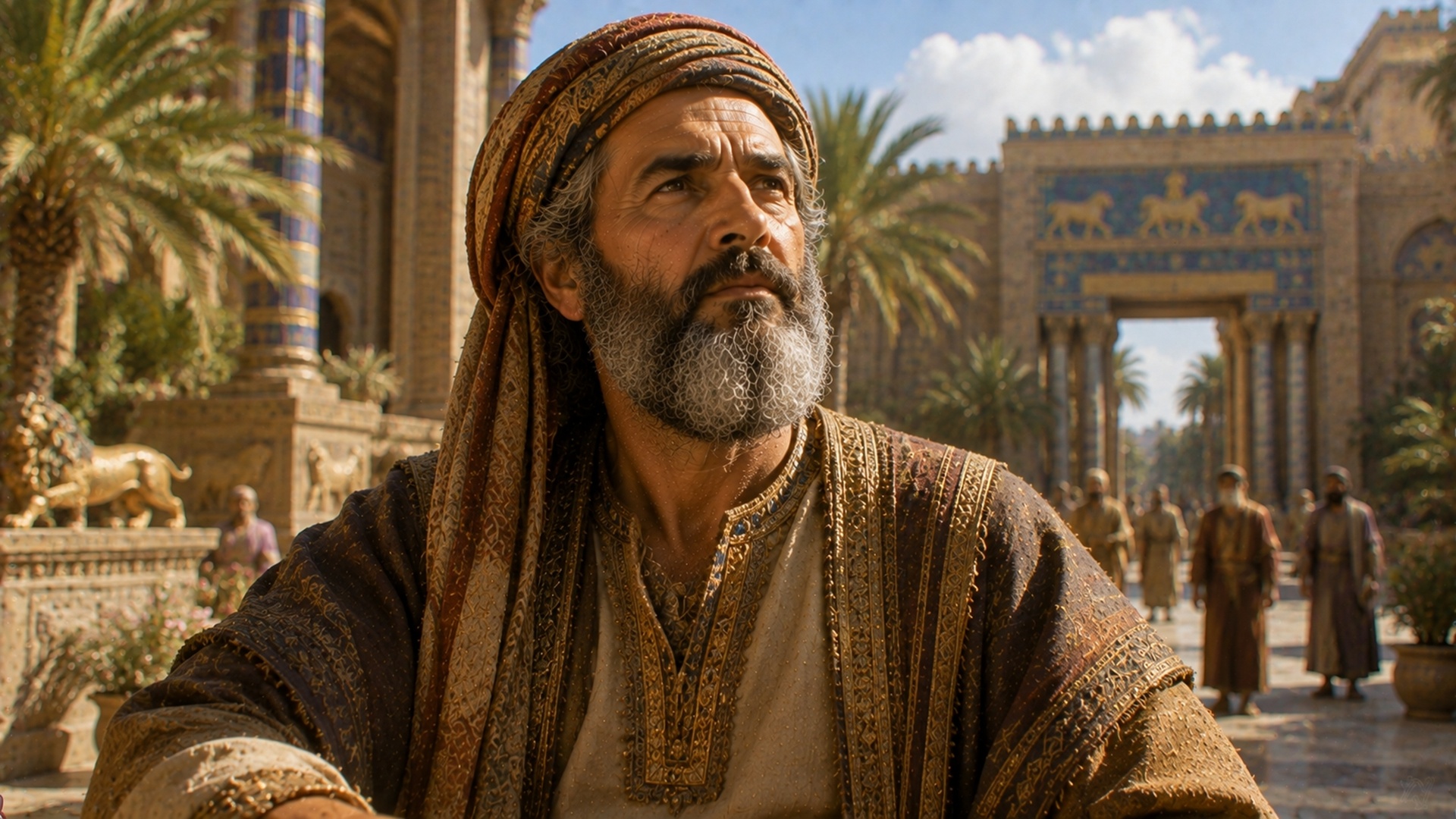
👤 The Biblical Person of the Day
🛡️ Mordecai – The Man Who Stood Faithfully
📌 Profile
- Name: Mordecai
- Time of Birth: approximately the 6th–5th century BC
- Place of Birth: probably within the Persian Empire
- Time of Death: unknown
- Age: unknown
- Occupation: Jew living in the Persian Empire, Esther’s foster father, and later a high-ranking official
📖 Short Story
Mordecai was a Jew who lived in Susa, the Persian capital. He belonged to the descendants of those who had been carried away from Judah and lived at a time when many Jews still resided outside their homeland.
When his young relative Hadassah, who was later called Esther, lost her parents, Mordecai took her into his home and raised her as his own daughter.
Esther was later taken into the palace of King Ahasuerus and eventually became queen. Mordecai remained nearby, cared about her welfare, and closely observed what was happening within the palace.
One day, Mordecai uncovered a conspiracy against the king. Esther reported the matter, and the king’s life was saved.
Mordecai’s greatest trial came, however, when Haman, a powerful official, demanded that everyone bow before him. Mordecai refused because his conscience and faith established boundaries that he would not cross.
Haman’s pride turned into hatred, not only against Mordecai but against the entire Jewish people. He devised a plan to destroy all the Jews throughout the Persian Empire.
During this crisis, Mordecai called Esther to accept her responsibility. He reminded her that she might have attained her royal position precisely for such a time as this. His story shows that faithfulness, courage, and trust in God during decisive moments can contribute to the preservation of an entire people.
🔥 The Decisive Moment
Mordecai called Esther not to keep her privileged position only for herself, but to intervene courageously on behalf of her people.
✨ Seven Remarkable Facts About Mordecai
- He was a Jew from the tribe of Benjamin.
- He lived in Susa within the Persian Empire.
- He raised Esther as his own daughter.
- He uncovered a conspiracy against the king.
- He refused to bow before Haman.
- He encouraged Esther to act courageously.
- He was later elevated and became a blessing to his people.
⚖️ Strengths & Weaknesses
✔ faithful
✔ courageous
✔ caring toward Esther
✔ steadfast in resisting inappropriate honor
❌ his steadfastness initially brought great danger
❌ little is reported about his personal inner struggles
❗ The Mistake That Shaped Him
The Bible does not record any particular personal mistake committed by Mordecai.
➡️ His life is characterized primarily by faithfulness, steadfastness, and the courage to accept responsibility at the right time.
📜 Key Verse
“Yet who knows whether you have come to the kingdom for such a time as this?” (Esther 4:14)
🧠 The Life Lesson
God can place people in a particular position so that, at the right time, they can stand courageously for truth, justice, and deliverance.
🎯 Application for Today
Ask yourself what responsibility God has entrusted to you at this moment. Perhaps you are not in your present position by chance, but have been called to be a faithful witness there.
❓ A Question for You
Where is God calling you today not to remain silent, but to accept responsibility faithfully and courageously?
📌 Context
Mordecai lived during the time of the Persian Empire, when Haman’s plan placed the Jewish people in deadly danger.
🔗 Connection
Mordecai is connected with Esther, King Ahasuerus, Haman, the Jewish people within the Persian Empire, and the establishment of the Feast of Purim.
Conclusion:
Mordecai shows us that faithfulness in hidden places and courage at a decisive moment can have far-reaching consequences. His story calls us to recognize God’s guidance even in paths through life that appear to be governed by coincidence.
See you tomorrow with the next biblical person! 📖
✨ The Life Story ✨
✨ The Life Story of Mordecai – Faithfulness at the Right Time ✨
🌄 A Jew in a Foreign Land
Mordecai lived in Susa, an important city within the Persian Empire. He belonged to the Jewish people, who had been scattered across foreign lands through the history of exile.
Although Mordecai lived in a foreign land, he did not forget his identity. He belonged to a people who carried God’s history, God’s covenant, and God’s promises with them.
His life shows that faithfulness to God is not bound to ideal surroundings. Even within a foreign empire, a person can live with a clear conscience and firm convictions.
🌸 Esther Is Entrusted to Him
Mordecai had a young relative named Hadassah, who was later called Esther. She had neither father nor mother, so Mordecai took her into his home.
He did not raise her coldly or merely out of obligation, but cared for her as his own daughter. Within a world filled with uncertainty, he provided her with protection, family, and guidance.
This care reveals a quiet greatness within Mordecai’s life. Before he became publicly known as an instrument in the deliverance of his people, he had already been faithful in private toward a child entrusted to his care.
👑 Esther in the Royal Palace
When young women were sought for the king, Esther was also taken into the palace. Mordecai could not simply control the path she was entering, but he remained vigilant and concerned for her welfare.
Day after day, he walked near the women’s quarters to learn how Esther was doing and what would happen to her.
Even after Esther became queen, Mordecai remained an important voice in her life. Her position within the palace did not erase her connection with the man who had raised her.
📜 A Conspiracy Is Uncovered
While Mordecai was sitting at the king’s gate, he learned about a conspiracy against Ahasuerus. Two men were planning to assassinate the king.
Mordecai did not remain silent. He reported the matter through Esther, and the conspiracy was investigated and confirmed.
His deed was recorded in the book of the chronicles, but Mordecai initially received no reward. He did what was right even when recognition did not follow.
⚠️ Haman Is Promoted
The king later promoted Haman and placed him above many of the princes. All the king’s servants were commanded to bow before Haman.
Mordecai, however, refused to bow. The Bible does not explain all his inner motives in detail, but his refusal shows that he recognized a boundary he was unwilling to cross.
Faithfulness was more important to Mordecai than conformity. He was unwilling to perform an action that violated his conscience merely to secure a personal advantage.
💔 Haman’s Hatred
Haman became furious when he saw that Mordecai refused to bow before him. His pride, however, was not satisfied with punishing Mordecai alone.
When Haman learned that Mordecai was a Jew, he planned to destroy the entire Jewish population throughout the empire.
The wounded pride of one man thus became a deadly threat to many people. Mordecai’s steadfastness brought to light a crisis in which God’s hidden guidance would become visible.
🧎 Mourning and Fasting
When Mordecai heard about the decree of destruction, he tore his clothes, put on sackcloth and ashes, and went out into the city.
His grief was public. He did not pretend that the danger was insignificant. Throughout the empire, the Jews wept, fasted, and mourned deeply.
Mordecai understood that this was not a minor political difficulty, but a matter of life and death for his people.
🛡️ The Appeal to Esther
Esther heard about Mordecai’s mourning and sent someone to him. Mordecai then had the news about Haman’s plan delivered to her and urged her to approach the king.
Esther knew how dangerous this would be. Anyone who entered the king’s presence without being summoned could be put to death unless the king extended the golden scepter.
Mordecai responded with solemn clarity. She must not imagine that she would remain safe within the palace. Deliverance would arise from another place, but perhaps she had attained her royal position precisely for such a time as this.
🌟 For Such a Time as This
These words belong among the most powerful statements in Esther’s story. Mordecai saw more behind Esther’s position than chance, beauty, or royal favor.
He recognized the possibility of divine providence. Perhaps God had placed Esther in that exact position so that she could intervene on behalf of her people during the decisive hour.
Mordecai did not force Esther carelessly into danger, but he reminded her of her responsibility. Some doors do not open for personal comfort, but for a calling.
🌅 Deliverance and a Reversal of Circumstances
Esther acted courageously. Through fasting, wisdom, and God’s hidden guidance, Haman’s plan was exposed.
The gallows Haman had prepared for Mordecai became the place of Haman’s own downfall. Mordecai was honored, promoted, and entrusted with a position of great responsibility.
His elevation, however, was not merely a personal benefit. It became a source of protection and help for his people.
🎉 Joy After the Threat
Mourning was turned into joy, and fear of death was replaced by deliverance. The days on which the Jews were supposed to be destroyed became days of victory and gratitude.
From that time onward, the Feast of Purim commemorated how God preserved His people, even though His name remains hidden within the Book of Esther.
Mordecai played an important part in this deliverance. His faithfulness in small matters, his courage during the conflict, and his clear appeal to Esther all became part of the story of rescue.
✨ The Enduring Message of His Life
Mordecai shows us that God prepares people in hidden places and positions them in particular circumstances. He was first a foster father, then a faithful official, afterward a steadfast Jew, and finally an instrument in the deliverance of his people.
His story reminds us that God’s guidance sometimes operates invisibly. At the right time, however, a faithful person can bring a great blessing through clear words and courageous action.
🌌 Closing Thought
Mordecai did not bow before inappropriate honor, did not remain silent during the crisis, and did not fail to remind Esther of her responsibility.
He understood that position, influence, and opportunity are not merely matters of chance, but can be used by God for a greater purpose.
👉 His life story shows that those who remain faithful to God and act courageously at the right time can become instruments through whom many people are protected.
