


🌿 Traces of Creation – Discoveries from Nature
🐟 3rd Series: Life in the Hidden Realm – The World of Fish
🧬 Episode 7 – Life in Hidden Places – Why Fish Remain Fish
📘 Introduction: Change Everywhere – Identity Remains
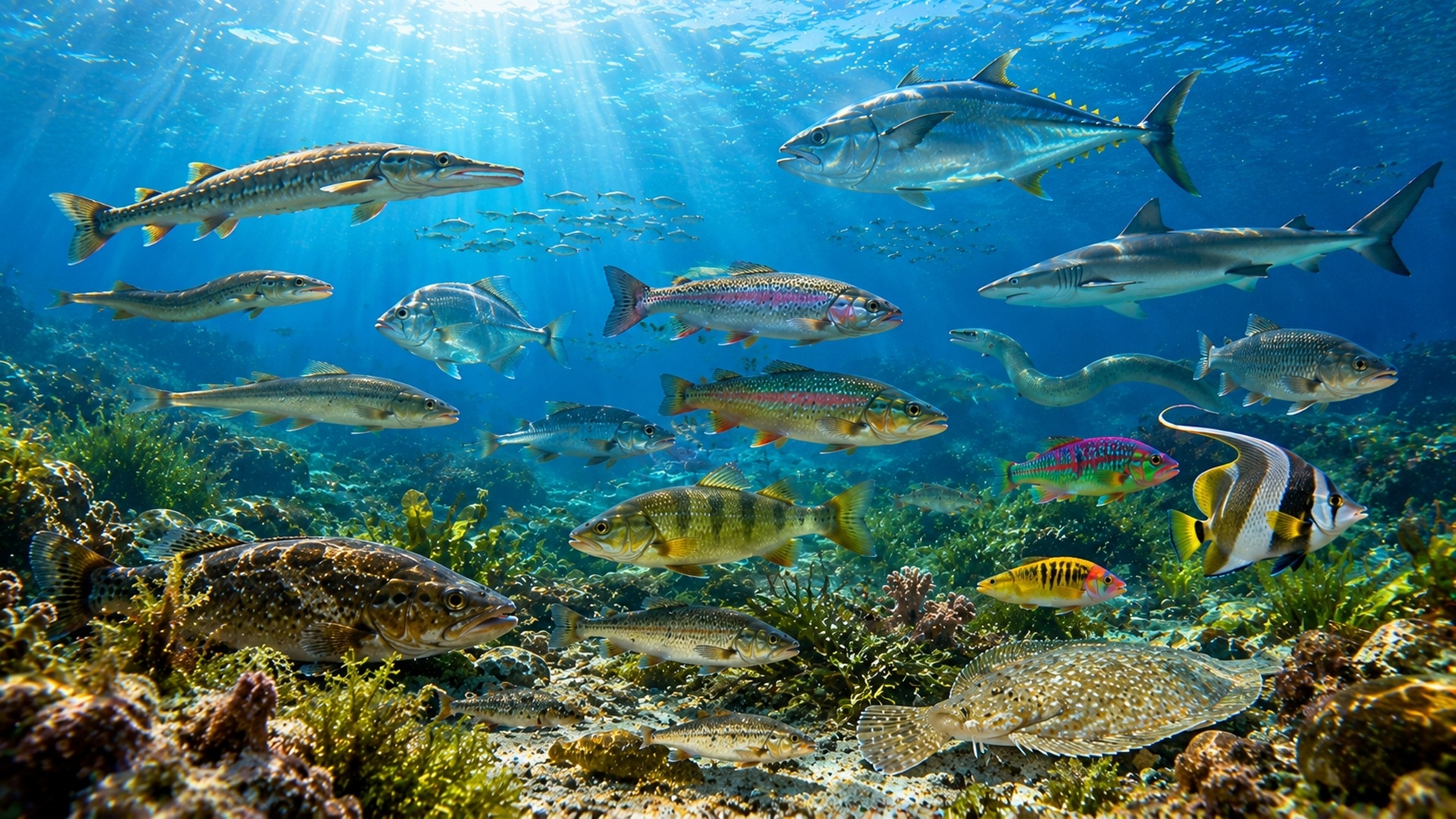
The world of fish is astonishingly diverse.
There are tiny species, barely larger than a fingernail,
and gigantic forms that cross the oceans.
Some live in icy depths, while others live in warm reefs or shallow pools.
And yet, something remarkable remains true:
No matter how different fish may be,
they remain fish.
A fish does not become an amphibian.
A bony fish does not become a shark.
A trout remains a trout.
Why do we observe so much adaptation,
but no unlimited transformation?
🧩 1. Great Diversity Within Clear Boundaries
The world of fish includes:
- bony fish
- cartilaginous fish
- jawless fish
There are differences in:
- body shape
- size
- fin arrangement
- habitat
- behavior
And yet, all fish share fundamental characteristics:
- life in water
- breathing through gills
- streamlined bodies
- fins for movement
- special sensory organs for the aquatic environment
These characteristics define
what a fish is.
Diversity develops within this framework,
not beyond it.
⚖️ 2. Adaptation Means Fine-Tuning, Not Redesign
Fish adapt to:
- currents
- temperature
- salinity
- depth
- food sources
These adaptations affect:
- fin size
- body shape
- metabolic rate
- behavior
But the basic concept remains stable.
A fish can:
- swim faster
- camouflage itself better
- hunt more efficiently
But it does not develop an entirely new principle of life.
Adaptation is optimization,
not reinvention.
🔗 3. Why Fundamental Changes Would Be Problematic
The characteristics of a fish are closely connected to one another.
Breathing, movement, perception, and metabolism
form a coordinated overall system.
A fundamental change in one part
would immediately require adaptations in many others,
all at the same time.
A fish cannot:
- lose its gills
- and continue living in water
Nor can it:
- fundamentally change the structure of its fins
- without losing its ability to swim
These systems leave no room
for arbitrary transitions.
🚫 4. Intermediate Forms Would Not Be an Advantage
As we have seen in previous episodes,
many fish characteristics function only as a complete system:
- efficient breathing
- stable movement
- orientation in water
A system that functioned only “partly”
would not be progress,
but a risk.
A fish that:
- breathed only in a limited way
- swam unsteadily
- perceived its surroundings poorly
would not get a second chance.
This explains
why we observe variation,
but not unlimited transformation.
🛡️ 5. Stability as the Foundation of Success
Fish are among the most successful vertebrates on Earth.
This success is not based on arbitrariness,
but on stability.
Because their basic structure is reliable,
they can:
- inhabit many environments
- feed in different ways
- adjust to environmental changes
Here, stability does not mean stagnation,
but the condition necessary for diversity.
📐 6. A Rational Consideration of Biological Boundaries
Every functioning system has boundaries.
A ship may be larger or smaller,
but it remains a ship.
Boundaries define:
- what is possible
- what makes sense
- what remains stable
In biology as well, boundaries
are not a sign of weakness,
but of functionality.
🌊 7. Why the Idea of Unlimited Change Seems Attractive
The idea of unlimited change
corresponds to human expectations of progress.
But nature reveals another principle:
Not everything that could change
is viable.
Consistency protects function.
Order preserves identity.
✝️ 8. The Christian Perspective: Order with Diversity
The Christian perspective speaks of created orders.
This means:
- diversity is intentional
- boundaries have meaning
- stability is part of care
Fish remain fish,
not because development is impossible,
but because order sustains identity.
Not as proof,
but as an interpretation
of what we observe.
🌿 9. What This Consistency Teaches Us
The fact that fish remain fish teaches us:
- diversity needs boundaries
- adaptation needs stability
- identity is not an obstacle, but a form of protection
Perhaps this observation also reminds us
that not every boundary must be overcome
in order to live meaningfully.
✨ Closing Thought
The world of fish is flexible, diverse, and dynamic.
But it is not arbitrary.
Change takes place
without the essence being lost.
Fish remain fish,
and precisely in this we see an order
that sustains.
Those who take this consistency seriously
will also discover here
traces of Creation.
